
Utah Alpine Lake Fishing: Aerial Stocking & Golden Trout
Fish dropped from airplanes, predators stocked to grow trophy brookies, and four subspecies of native cutthroat being restored
Riley Thompson
June 15, 2025
16 min read
TLDR
Utah's Division of Wildlife Resources runs one of the most creative alpine lake stocking programs in the country. This is how it all works.
The highlights:
- Aerial stocking since 1956 - 35,000 fingerlings per flight, dropped from a Cessna at 70 mph
- 300+ lakes stocked by plane each year, 40-60 in a single day
- Sterile tiger muskie stocked as predators to grow trophy brook trout
- 2 million cutthroat produced annually across 8 genetic strains
- 4 native subspecies being restored via rotenone treatments
- 35% of Boulder Mountain managed specifically for trophy brookies
- State record brook trout: 7 lbs, 8 oz (Boulder Mountain, 1971)
Aerial Stocking: Dropping Fish From the Sky
Utah has over 1,000 natural lakes in the High Uintas alone. Most of them are above 10,000 feet. Many have no road access whatsoever. How do you stock fish in lakes you can't drive to?
You drop them from airplanes.
How It Actually Works
Utah has been aerial stocking since 1956 - possibly earlier, though the exact origin is unclear. The program uses a Cessna 185 Skywagon, a single-engine aircraft modified with seven separate holding tanks.
The setup:
- Each flight carries up to 84 pounds of fingerlings
- The plane can hold 35,000 fish (1-3 inches long) per flight
- Seven tanks mean seven lakes per flight without returning to reload
The drop:
- Pilot flies 50-150 feet above the water surface
- Airspeed: 70-80 mph
- Fish are released through valves in the tanks
- The fingerlings are small enough that air resistance slows their descent
The physics work in the fish's favor. At 1-3 inches long, the fingerlings essentially float down on air resistance - like tiny fish parachutes. Post-drop survival surveys show this method actually stresses fish less than ground transport, where water in portable tanks sloshes around, oxygen levels fluctuate, and temperatures can spike during hours of rough backcountry driving.
The Scale
- 300+ lakes aerially stocked each year
- 40-60 lakes can be stocked in a single day
- 12.8+ million fish stocked statewide in 2024 (all methods combined)
- 722 waterbodies received fish in 2024
- Aerial stocking runs July through September
Popular lakes get restocked annually. Others operate on 3-5 year rotations depending on how well populations sustain themselves through natural reproduction.
What Gets Dropped
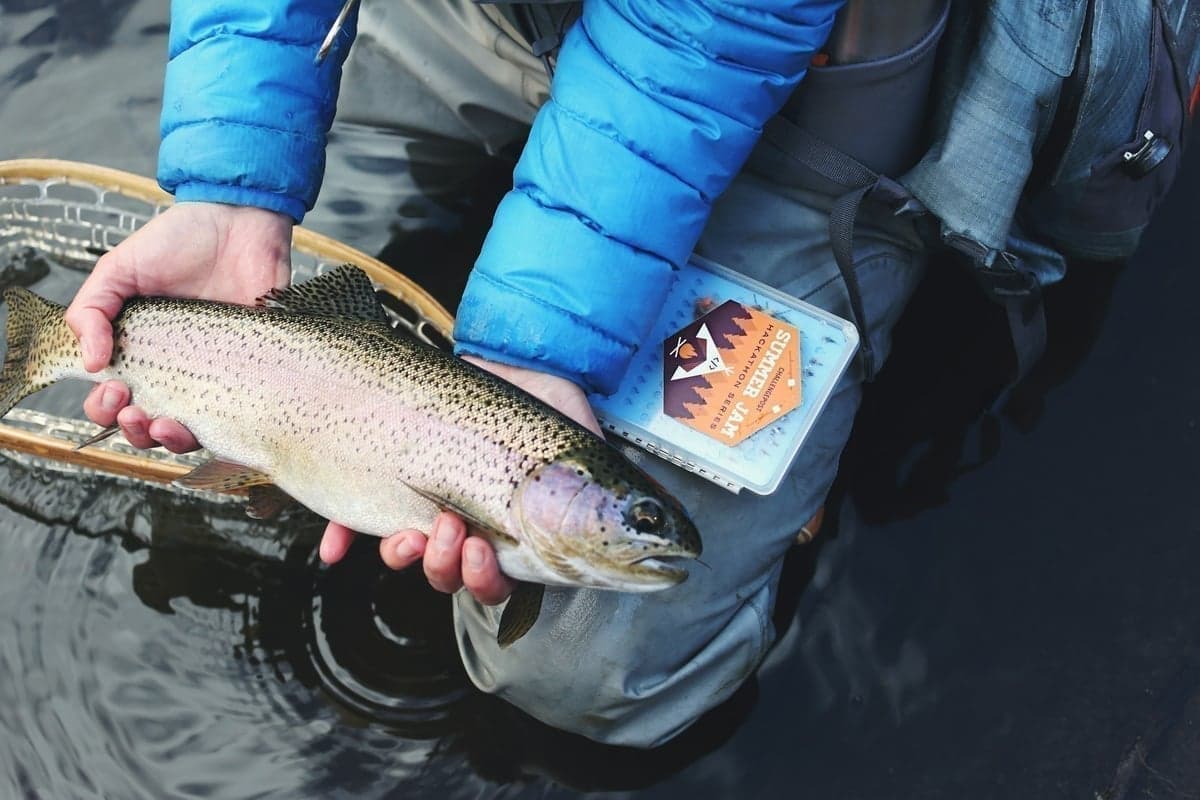
Rainbow trout - one of several species dropped from planes into Utah's backcountry lakes
This isn't just a rainbow trout operation. Utah aerially stocks:
- Brook trout - The workhorse species for alpine lakes
- Cutthroat trout - Utah's only native trout (multiple subspecies)
- Tiger trout - Brook/brown trout hybrid (sterile)
- Splake - Brook/lake trout hybrid (sterile)
- Arctic grayling - Non-native but thrives in marginal high-elevation lakes
- Rainbow trout - The classic
- Golden trout - Extremely limited distribution
The non-native species (other than cutthroat) are usually sterile. This is intentional - it gives biologists an exit strategy. If they decide to stop stocking a species, the population dies out naturally. No uncontrolled spread into native cutthroat habitat.
The Sterile Hybrid Strategy
Utah makes heavy use of sterile hybrid fish. This isn't accidental - it's a core management tool.
Tiger Trout
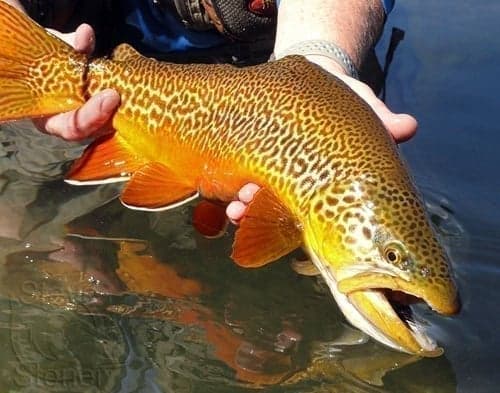
Tiger trout - the striking brook × brown trout hybrid with distinctive vermiculated markings
Tiger trout are a brook trout × brown trout cross. They're sterile, which means:
- They can't reproduce
- They don't waste energy on spawning
- They focus entirely on eating and growing
- Populations can be controlled precisely through stocking rates
Tiger trout grow fast and aggressive. They're stocked into lakes where managers want predatory pressure on smaller fish, or where they want to provide angling opportunity without establishing a self-sustaining population.
Splake
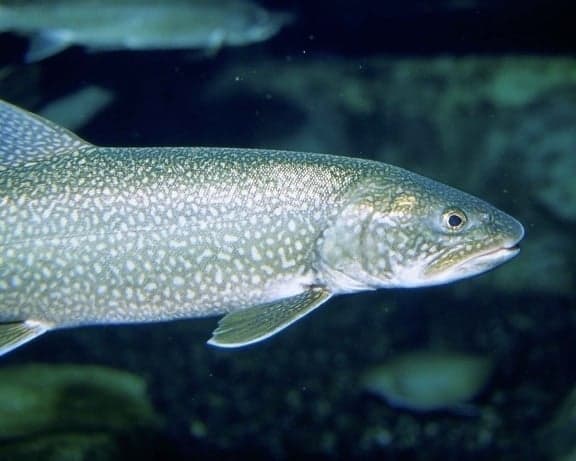
Splake - the brook × lake trout hybrid that can reach over two feet
Splake are brook trout × lake trout hybrids. Like tiger trout, they're functionally sterile in the wild (reproduction is theoretically possible but behaviorally rare outside hatcheries).
Key characteristics:
- Grow larger than brook trout
- Become piscivorous (fish-eating) at a younger age
- More tolerant of competition than pure brook trout
- Used in waters with stunted brook trout populations
Colorado pioneered using splake to control stunted brook trout. The splake prey on small brookies, reducing competition while growing to impressive sizes themselves.
In 2022, Utah introduced around 40,000 splake (4-5 inches) into Jordanelle Reservoir. These fish can reach over two feet at maturity.
Why Sterility Matters
The sterility of these hybrids is a feature, not a bug. It gives the DWR flexibility to:
- Stock fish without permanent consequences
- Remove species from a management plan by simply stopping stocking
- Experiment with different approaches in different lakes
- Avoid genetic contamination of native cutthroat populations
If something isn't working, they just stop. The fish eventually die off.
The Trophy Brook Trout Experiment
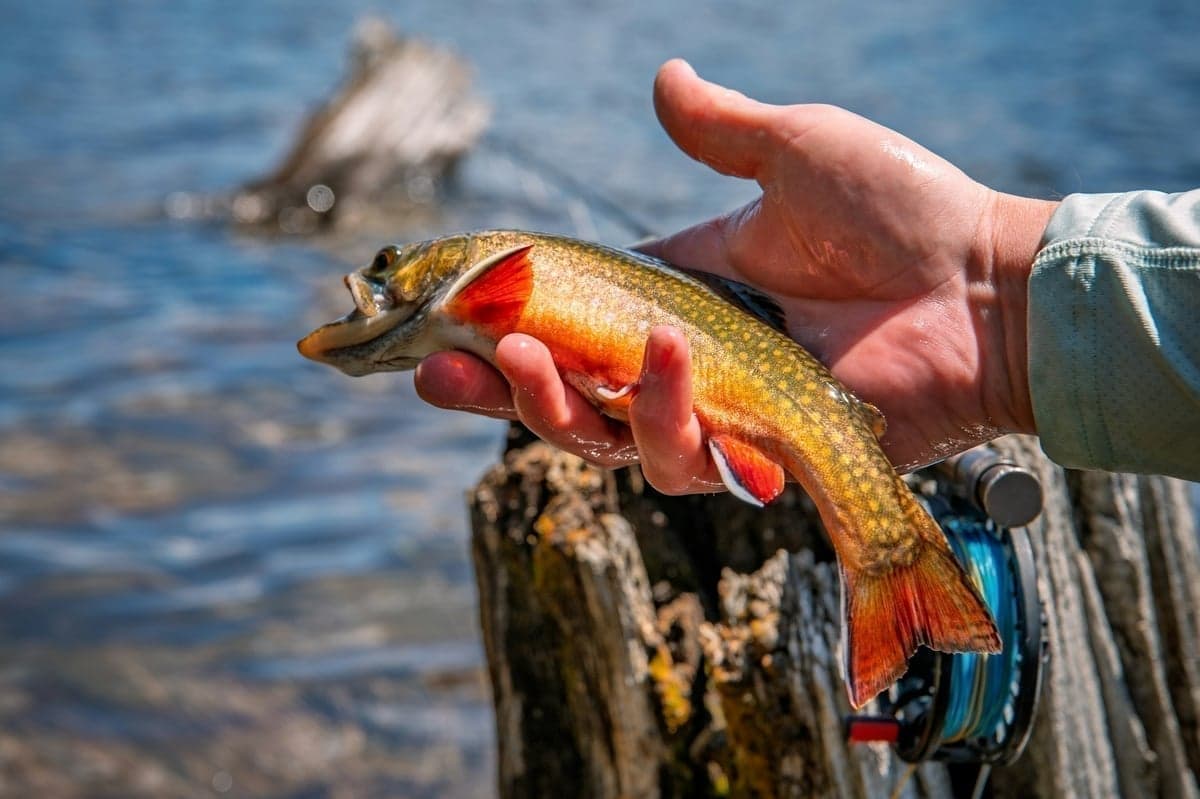
Brook trout - beautiful but prolific, which leads to stunting in alpine lakes without management
Brook trout are beautiful but problematic. They reproduce prolifically, especially in alpine lakes. When food is limited (which it often is at 10,000+ feet), brook trout populations explode and individual fish stunt.
The result: thousands of 6-inch fish instead of hundreds of 14-inch fish.
The Predator Solution
Idaho's Department of Fish and Game had an idea: what if you stocked apex predators into these stunted brook trout lakes?
They tried tiger muskie - northern pike × muskellunge hybrids. Tiger muskie are:
- Completely sterile
- Fully piscivorous (they only eat fish)
- Aggressive and fast-growing
- Large enough to prey on brook trout
The Results
Idaho ran a five-year study across 17 alpine brook trout lakes. The results were dramatic:
| Metric | Before Tiger Muskie | After Tiger Muskie |
|---|---|---|
| Brook trout per net | 23.1 | 2.3 |
| Proportion over 10 inches | Low | Significantly increased |
Fewer fish competing for the same food supply = bigger fish. The tiger muskie ate the small brookies, reducing competition, and the survivors grew to trophy size.
Utah adopted this approach in several alpine lakes including Cottonwood Reservoir, Donkey Lake, and Bullock Reservoir. As fisheries biologist Bryan Englebert put it, the tiger muskie "were serving the same purpose in those lakes that they do in most others - controlling fish populations."
Boulder Mountain: Trophy Brookie Central
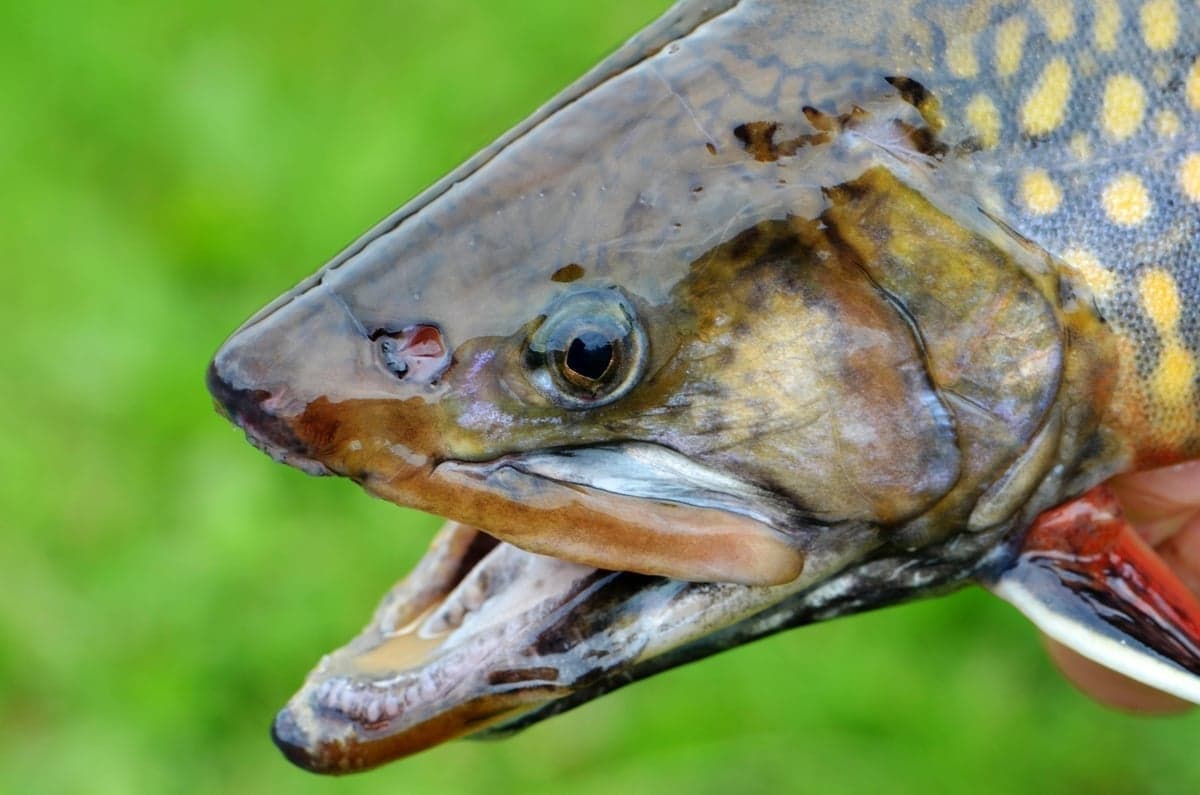
Trophy brook trout like this are the goal on Boulder Mountain - where 35% of lakes are managed specifically for big brookies
Boulder Mountain in southern Utah takes the trophy brook trout concept further than anywhere else in the state.
The numbers:
- 80+ lakes, ponds, and reservoirs
- 35% managed specifically for trophy brook trout
- 83% have a trophy fish component in the management plan
- State record brook trout: 7 lbs, 8 oz (caught on Boulder Mountain, 1971)
A Public Involvement Committee recognized the "history and long-standing tradition of trophy brook trout fishing on the mountain" and built the management plan around it. The mountain is divided into management zones (North Creek, North Slope, South Slope, East Slope, West Slope, Boulder Top, Griffin Top, Escalante Mountain), each with specific strategies.
Why the fish grow so big:
- Abundant forage: scuds over an inch long, leeches, baitfish
- Active management to prevent stunting
- Strategic predator introductions
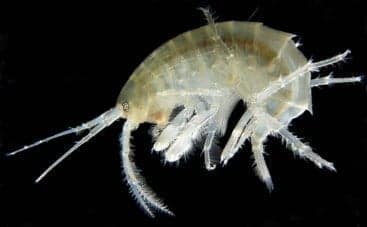
Scuds (freshwater amphipods) - the protein-rich forage that fuels trophy brook trout growth on Boulder Mountain
One angler reported catching a 17-inch female brook trout that weighed around 4 pounds: "Fish this shape seem to grow in thickness as fast as length."
New experiment (2022): Biologists stocked kokanee salmon into Blind Lake on Boulder Mountain. The goals: give anglers a chance to catch kokanee from shore (usually requires a boat), and provide additional forage for splake, brook, and cutthroat populations.
Native Cutthroat Restoration
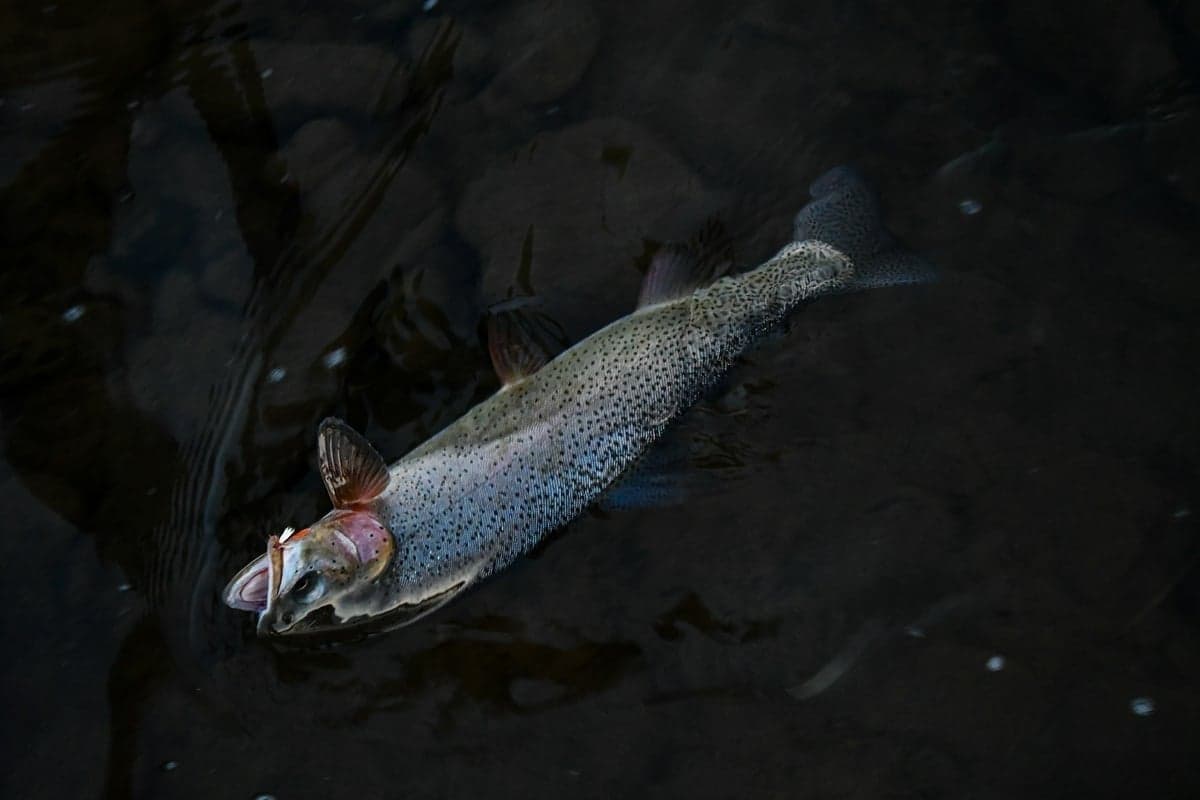
Cutthroat trout - Utah's only native trout, with four distinct subspecies being restored across the state
Cutthroat trout are the only trout native to Utah. Everything else - brook trout, brown trout, rainbow trout - was introduced in the late 1800s when people wanted to "improve" fishing opportunities.
The introductions worked too well. Non-native trout now compete for food and habitat, prey on young cutthroat, and (in the case of rainbow trout) hybridize with cutthroat, diluting their genetic integrity.
Colorado River cutthroat now occupy only 11% of their historical range.
The Four Subspecies
Utah has four genetically distinct cutthroat subspecies, each adapted to different drainages:
1. Bonneville Cutthroat
- Utah's state fish
- Native to the ancient Lake Bonneville Basin (north, central, and western Utah)
- Once believed extinct - rediscovered in the 1970s
- Target: 35% of historic range recovery
2. Bear River (Bear Lake) Cutthroat
- Native to Bear River and tributaries, including Bear Lake
- DNA shows closer relation to Yellowstone cutthroat than other Utah subspecies
- Historically called "Blue Noses" due to blue coloration on lake-dwelling fish
- Primarily piscivorous (fish-eating) - unusual for cutthroat
- Target: slightly over 50% of historic range recovery
3. Colorado River Cutthroat
- Native to eastern and southeastern Utah (Colorado River drainage)
- The most colorful subspecies - "the most beautiful fish you can find in the state"
- Currently occupies only 11% of historical range
- Target: 25% of historic range recovery
4. Yellowstone Cutthroat
- Rarest subspecies in Utah
- Native range limited to the Raft River Mountains in the northwest corner
- The most challenging catch for the Utah Cutthroat Slam
- Target: greater proportion of native range than other subspecies
The Rotenone Treatment Process
To restore cutthroat to a drainage, biologists first have to remove non-native fish. The tool: rotenone.
What is rotenone?
- A natural compound from roots of tropical plants in the bean family
- Respiratory toxin to fish - disrupts oxygen transfer in gills
- Not dangerous to people, pets, or other wildlife at treatment concentrations
- Neutralizes within 1-5 hours of downstream travel
- EPA-approved for fisheries management
How treatments work:
-
Target selection: Choose streams/lakes with downstream barriers (natural waterfalls or installed dams) that prevent reinvasion by non-natives
-
Treatment application: Apply rotenone 2-3 times over several years to ensure complete removal of non-native fish
-
Rapid restocking: Stock native cutthroat within weeks of final treatment
-
Multi-year support: Continue annual cutthroat stocking for 3-5 years until natural reproduction sustains the population
-
Interim fishing: In popular areas, stock sterile tiger trout temporarily to provide fishing opportunity while cutthroat establish
Current Projects
Over the past decade, DWR biologists have treated waterbodies on both the north and south slopes of the Uintas. The work continues:
2025 treatments:
- Fall Creek drainage
- Phinney Lake and Anderson Lake targeted for Colorado River cutthroat stocking in 2026 (if treatment succeeds)
Larger effort:
- Treating upper portions of streams connected to Sheep Creek Canal
- Goal: create a "meta-population" - multiple connected cutthroat populations that can recolonize each other after catastrophic events
- Oweep drainage: 15.8 miles being cleared of brook trout for pure Colorado River cutthroat restocking
For brook trout anglers worried about access: "Even though brook trout are being removed from treatment areas, anglers can still find them in thousands of streams and lakes throughout the Uinta Mountains."
The Conservation Math
Eight cutthroat restoration projects are planned over the next decade. When complete:
| Subspecies | Historic Range Recovery |
|---|---|
| Bear River | ~50% |
| Bonneville | 35% |
| Colorado River | 25% |
| Yellowstone | Higher % (smaller native range) |
A 2022 DWR survey found that 47% of anglers prefer catching cutthroat trout, but "anglers think there are too few cutthroat trout fishing opportunities in Utah." The restoration program addresses both conservation and angler demand.
The Utah Cutthroat Slam
The DWR and Trout Unlimited created the Utah Cutthroat Slam in 2016 - a conservation-focused fishing challenge.
The challenge: Catch and photograph all four native cutthroat subspecies.
Completions: 1,653 anglers have finished the Slam as of 2024, a record year.
The hardest catch: Yellowstone cutthroat, limited to the remote Raft River Mountains in Utah's northwest corner.
Register at utahcutthroatslam.org.
The Golden Trout Program
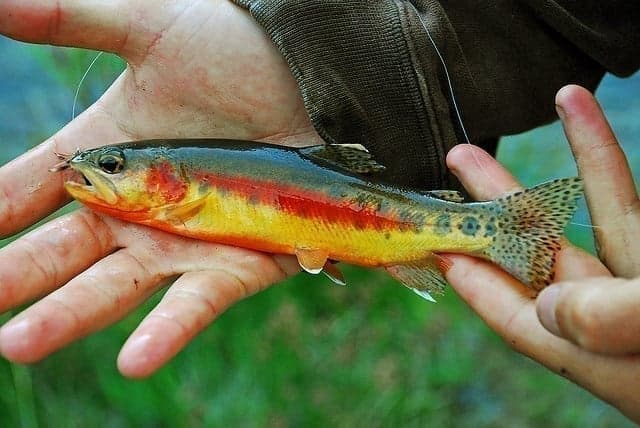
Golden trout - California's state fish, stunningly beautiful but limited to just two areas in Utah's High Uintas
Golden trout are California's state fish - native only to the southern Sierra Nevada. They're striking, with brilliant gold and red coloration. Utah has managed them since the 1920s, but the history is rocky.
The Problem
Golden trout didn't evolve with other trout species. They can't compete. When brook trout invaded or were stocked into golden trout waters in the 1950s, the goldens lost. Population after population disappeared.
Utah stocked more lakes with golden trout in the 1960s and 1970s. Same result - brook trout eventually took over.
Current Status
Golden trout survive in just two areas of the High Uintas:
Atwood Creek Drainage:
- Atwood Lake (U-16)
- Mt. Emmons Lake (U-13)
- Lake U-19
- Stocked with ~13,000 one-inch goldens in 2012
- Requires 18-mile hike to access
Murdock Basin:
- Echo Lake (Z-16)
- Received 11,000+ five to six-inch golden trout (2013-2014)
- Accessible via rough 4WD road
The DWR worked with Wyoming Game and Fish to obtain golden trout eggs, restarting stocking in 2012 after years of no supplementation.
State records:
- Catch-and-keep: 14.5 inches (14 oz) from Atwood Creek, 1977
- Catch-and-release: 11 1/8 inches from Echo Lake, 2008
Why No Expansion?
Boulder Mountain would seem like logical golden trout habitat. But there's too much native cutthroat range there. Golden trout can hybridize with cutthroat, which would compromise native fish genetics.
"Add to that the problem with brook trout on that mountain, and it would be a recipe for disaster."
No plans exist to stock golden trout elsewhere in the state.
Arctic Grayling: The High-Altitude Specialist
Arctic grayling aren't native to Utah. But they fill a niche that native fish can't.
Why Grayling?
Some high-elevation lakes have low winter oxygen levels - too low for trout to survive year-round. Grayling evolved in harsh Arctic conditions and tolerate these marginal environments.
By stocking grayling, the DWR provides fishing opportunity in lakes that would otherwise be fishless.
Current Distribution
- 46 lakes in the High Uintas hold grayling
- Experimental stocking expanded in 2024 to evaluate additional lakes
- Grayling are stocked on 3-year rotations in most waters
Key drainages with grayling:
- Provo River: Weir, Blue, Marjorie, Trial, Wall lakes
- Weber: Fish, Round, Sand lakes; Smith & Morehouse Reservoir
- Bear Lake: Whiskey Island Lake
- Duchesne: Carolyn Lake
State record: 1 lb 12 oz from Big Dog Lake, 1998
Grayling Characteristics
Known for their spectacular sail-like dorsal fin, grayling are sometimes called "freshwater sailfish." They're aggressive dry fly eaters with soft mouths - easy to hook, easy to lose during the fight.
The Hatchery Infrastructure
All of this requires serious production capacity.
Statewide Numbers (2024)
- 12.8+ million fish stocked
- 1.2+ million pounds of fish
- 722 waterbodies received stockings
- 2 million cutthroat produced annually
- 300+ waterbodies receiving cutthroat specifically
Hatchery Facilities
Utah operates 13 fish hatchery facilities with a new one under construction:
Mantua Fish Hatchery:
- First constructed in 1910
- Produces ~6 million trout eggs per year
- 30% of total trout stocked in Utah
- Primary production: Bear Lake cutthroat and rainbow trout
Loa Fish Hatchery:
- Historically the largest facility: 180,000 pounds/year capacity
- Currently being rebuilt (completion 2027)
- Primary production: rainbow and cutthroat trout
Fountain Green Hatchery:
- 1,000,000 fish (~180,000 pounds) yearly
- Produces rainbow, cutthroat, and tiger trout
Genetic Diversity
The DWR doesn't just produce "cutthroat trout" - they maintain eight different cutthroat genetic groups and five separate rainbow strains. This preserves the genetic distinctiveness of each subspecies and allows targeted stocking for conservation goals.
Why This Matters
Most state fish stocking programs are straightforward: raise trout, stock trout, let people catch trout.
Utah's approach is more like a massive, ongoing fisheries experiment:
- Aerial delivery to reach 300+ otherwise-unfishable lakes
- Sterile hybrids for population control without permanent consequences
- Predator stocking to grow trophy fish instead of stunted populations
- Chemical treatments to restore native subspecies
- Trophy management on specific waters (35% of Boulder Mountain)
- Eight genetic strains of cutthroat maintained for conservation
- Species diversity including grayling and golden trout in targeted habitats
The result is 500+ alpine lakes with genuine variety - not just the same rainbow trout experience everywhere.
And somewhere up there, a pilot in a Cessna 185 is dropping thousands of fingerlings into lakes most people have never heard of.
Resources
Stocking Database: Check what was stocked where and when at dwrapps.utah.gov/fishstocking
Regulations: Current rules at wildlife.utah.gov
Utah Cutthroat Slam: Register and track your progress at utahcutthroatslam.org
Ranger Districts:
- High Uintas: Kamas Ranger District, 435-783-4338
- Boulder Mountain: Escalante Ranger District, 435-826-5499
Frequently Asked Questions
How are alpine lakes stocked with fish in Utah?
Utah stocks over 300 alpine lakes annually by airplane, dropping 35,000 fingerlings per flight from a Cessna at 70 mph. This aerial stocking program has been running since 1956, targeting high-elevation lakes with no road access in the Uinta Mountains and Boulder Mountain.
Can you fish alpine lakes in Utah?
Yes, most of Utah's 1,000+ alpine lakes are open to fishing. The High Uintas Wilderness alone holds hundreds of fishable lakes above 10,000 feet, many stocked with brook trout, cutthroat, and in select cases golden trout. Check current regulations at wildlife.utah.gov.
Where can I find golden trout in Utah?
Golden trout are stocked in select high-elevation lakes in Utah's Uinta Mountains. These lakes are typically remote and require backpacking to access. Contact the Kamas Ranger District (435-783-4338) for current stocking locations and trail conditions.
Get River Intel Weekly
Flow updates and fishing intel delivered every Thursday.
River Intel Weekly
Weekly flow updates and fishing intel.
© 2026 RiverReports, Inc.