Quick Reference
| What | When | Key Numbers |
|---|
| Guadalupe River trout | Nov - May (stocking Dec - Mar) | 60-150 CFS ideal wading; artificial lures only in trophy zones |
| Hill Country bass | Year-round (best Mar - Jun, Oct - Nov) | S. Llano: 40-150 CFS; San Marcos: 100-200 CFS; Llano: 150-500 CFS |
| Devils River expedition | Spring - early fall | 4-day trips; book 5+ months ahead; $1,500-$2,750/person |
| Guided trips | Book by October for winter trout | $350-$600/day (1-2 anglers) |
| Fly shop | Lone Star Fly Fishing | (281) 382-2871, 14121 River Rd, New Braunfels |
Flow110 CFS
Trendstable
Clarityclear
Temp72°F
Topwater Poppers white/chartreuse #6-8Clouser Minnows chartreuse/white #4-6Grasshopper Patterns #8-10Crayfish Patterns #6
Flow108 CFS at Sattler
Trendfalling
Clarityclear
Temp~63°F near dam, warming to 83°F+ below Mile 3
Clouser Minnows chartreuse/white #4-6BH Woolly Buggers black/olive #10-12Topwater Poppers white #6-8Grasshopper Patterns #8-10
Flow233 CFS
Trendfalling
Clarityclear
Temp85°F
Clouser Minnows chartreuse/white #4-6Woolly Buggers olive/black #6-8Crayfish Patterns #4-6Topwater Poppers white/chartreuse #6-8
Flow200 CFS
Trendfalling
Clarityclear
Temp85°F
Topwater Poppers white/chartreuse #6-8Grasshopper Patterns #8-10Clouser Minnows chartreuse/white #4-6Woolly Buggers olive/black #8-10
🎣 TACTICS RIGHT NOWDry FlyPeak terrestrial season across the Hill Countrywith extreme heat making the San Marcos the clear surface fishing winner. The San Marcos at 110 CFS with 72°F spring-fed water is the standout: Grasshopper Patterns #8-10 along grassy banks are the top producerTopwater Poppers white/chartreuse #6-8 at dawn along shaded cypress structure for explosive Guadalupe bass strikesFoam Beetles #12-14 and Deer Hair Ants #14-16 through riffles for cichlids and panfish. The spring-fed 72°F water extends the productive surface window well past 9am — critical when freestone rivers are pushing 85°F in this sustained triple-digit heat and bass shut down by mid-morning. The tailwater at 108 CFS is the headline this week — flows have dropped into the ideal 60-150 CFS wading rangeand the calmer water makes topwater poppers white #6-8 highly effective along cypress roots and in riffles. The best wade-and-topwater conditions on the tailwater since before July's floods. The Llano at 233 CFS with clear water remains prime topwater territory — poppers white/chartreuse #6-8 and grasshopper patterns #8-10 tight to shaded banks at dawn. The freestone Guadalupe at 200 CFS supports topwater along shaded cypress banks at dawn. Dawn to 9am is absolutely non-negotiable in this extreme heat across all rivers — no exceptions.
NymphSubsurface fishing productive across all Hill Country rivers in late August. Trout nymphing done for the season — leave holdover rainbows alone until November stocking. On the tailwater at 108 CFSstrike indicator nymph fishing in deeper sections remains the most productive technique per the Orvis August 19 report — Hare's Ear nymphs #14-16Rojo Midges #20-22and Micro Eggs (orange). At 108 CFS the current is slow and controlled — perfect for precise drift presentations that were trickier at higher flows. Crayfish Patterns #6-8 for Guadalupe bass and largemouth bounced through deeper eddies and pool heads. Pat's Hot Tail Mini-Craw for Rio Grande cichlids on the San Marcos at 110 CFS — target along banks and near structure. The Llano at 233 CFS with clear water is productive for nymphing — crayfish patterns #4-6 bounced along the bottom in deeper poolsbass holding on limestone structure. The freestone Guadalupe at 200 CFS supports crayfish patterns #6-8 through deeper runs and eddies. In this extreme late-August heat (100-106°F)subsurface fishing significantly outproduces topwater after the first hour of daylight as bass retreat to deepercooler holds.
StreamerStreamer fishing productive across the Hill Country. The tailwater at 108 CFS — now fully in the ideal wading range — offers the best wade-and-strip streamer fishing in weeks. The slowclear current means longermore deliberate strips with pauses. BH Woolly Buggers black/olive #10-12 through deeper runs and pool headsClouser Minnows chartreuse/white #4-6 stripped along shaded banks. The Llano at 233 CFS offers excellent streamer fishing on float trips — Clouser Minnows chartreuse/white #4-6 with aggressive strips through deeper bank runs and Woolly Buggers olive/black #6-8 swung through pool tails are the top producers in the clear water. The freestone Guadalupe at 200 CFS is prime for Clouser Minnows and Woolly Buggers worked through shaded cypress root systems and limestone structure. The San Marcos at 110 CFS offers Drunk n Disorderly and Ball Peen Craw patterns for larger bass along submerged timberSmall Frog Patterns #6 for largemouth in slower pools at dawn. Streamers remain the most efficient way to search for bass on float trips across all rivers.
FORECASTThe Hill Country remains fishable heading into the final days of August, with the tailwater entering its best phase in over a month. Canyon Lake releases have eased flows to 108 CFS at Sattler — squarely in the ideal 60-150 CFS wading range — the best conditions for wade anglers since before the July floods. Canyon Lake at 100% full, 909.39 feet (August 25), slowly easing toward the 909.00 ft conservation elevation as releases continue. Four weeks of extreme heat (100-106°F daily) with no measurable rain are drawing down all rivers and aquifer levels. Edwards Aquifer J-17 was at 649.8 feet (10-day avg) as of August 6 when EAA escalated to Stage 2 restrictions — the aquifer has continued declining through August. The San Marcos at 110 CFS with 72°F spring-fed water remains the most reliable option, with spring discharge measured at 126 CFS on August 4. The Llano at 233 CFS and freestone Guadalupe at 200 CFS are easing but remain solidly fishable. At the current rate of decline (~5 CFS/day on freestone rivers), the Llano and freestone Guadalupe could approach the 150 CFS wading/floating threshold by mid-September if no rain arrives. The tailwater will continue to be dictated by Canyon Lake releases — if the lake continues its slow decline below conservation elevation, releases may decrease further, which would be even better for wade anglers. This is exclusively warmwater fishing through October — Guadalupe bass, largemouth, Rio Grande cichlids, and panfish. Trout season resumes with November stocking.Extreme late-summer heat continues to dominate the Hill Country as August closes out. Daily highs running 100-106°F with heat indices exceeding 110°F — the fourth consecutive week of triple-digit temperatures. No measurable rain since late July and none forecast through the end of August. Edwards Aquifer J-17 at 649.8 feet (10-day avg as of August 6) — EAA at Stage 2 restrictions since August 6 as the aquifer gives back July's gains. Canyon Lake at 100% full, 909.39 feet (August 25) — slowly easing from 909.50 feet, releases continuing to decrease (tailwater dropped from 154 to 108 CFS since August 22). Water temps: ~63°F in the upper tailwater cold zone near Canyon Dam (per Orvis August 19 report), 85°F on freestone rivers (Guadalupe, Llano) — running a degree hotter than last week as the heat streak extends, 72°F on the spring-fed San Marcos. Dawn-to-9am is absolutely non-negotiable — this remains the hottest stretch of the summer. The San Marcos is the one exception where 72°F water extends productive fishing past 9am. Flash flood risk currently low with no rain in the forecast, but Hill Country thunderstorms can develop rapidly — always check forecasts. Best fishing this week: the tailwater at 108 CFS for ideal wade fishing conditions, the San Marcos for comfort and reliability in the extreme heat, and the Llano for float-trip topwater fishing at dawn.
Overview
Texas is not the first state most fly anglers think of, and that's exactly what makes it worth fishing. The Hill Country holds clear, spring-fed rivers lined with bald cypress, the Guadalupe River below Canyon Lake ranks among the nation's top 100 trout streams, and the Devils River offers one of the most pristine wilderness float-fishing experiences in the lower 48. Add in the Guadalupe bass: the state fish, found nowhere else on earth, and Texas quietly delivers some of the most diverse fly fishing in the South.
The state's fly fishing splits into three distinct categories: winter trout fishing on the Guadalupe River tailwater, year-round warmwater fishing for bass and panfish on Hill Country streams, and remote multi-day expeditions on the Devils River. Each appeals to a different kind of angler, but all share one thing: low fishing pressure compared to Western destination rivers.
The Rivers
Guadalupe River (Below Canyon Lake)
The Guadalupe below Canyon Dam is one of the southernmost year-round trout fisheries in the United States. Cold water releases from the bottom of Canyon Lake keep temperatures in the 50s°F through the trophy trout zone, supporting rainbow trout year-round in the upper miles.
Trout Unlimited and Texas Parks and Wildlife stock the river with rainbow trout from late November through March: roughly 18,000 fish at the Canyon Tailrace alone across 10 stocking dates during the 2025-2026 season. Fish average 12-14 inches, with 20-inch trout not uncommon and specimens reaching 5-8 pounds.
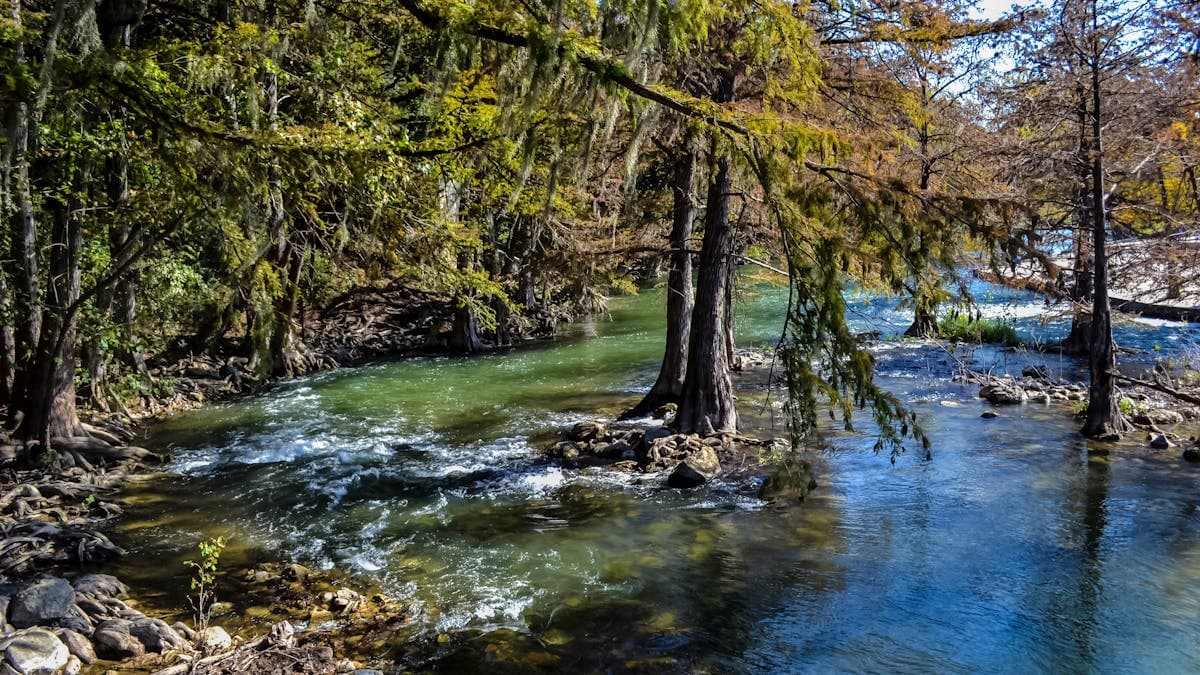
What makes it special: This is legitimate tailwater trout fishing an hour from Austin or San Antonio. The bald cypress-lined banks and limestone cliffs make it visually striking, and the hatch diversity (midges year-round, BWOs and caddis April-October, Hexagenia in summer) rivals many Western rivers.
Access: The streambed below Canyon Lake is publicly owned, but both banks are private property. Float trips are the primary access method, though a few public access points exist:
- Guadalupe Park (Army Corps of Engineers), year-round access
- Camp Huaco Springs: free TPWD access, December through early March during stocking season
- Action Angler on Guadalupe River Road, $10/person walk-in wade access, one of the most practical options for visiting anglers without a guide
- Stocking locations: Guadalupe Park, Whitewater Camp, 4th Crossing, 3rd Crossing, and Camp Huaco Springs
Flow windows:
- 60-150 CFS: Ideal wading and float fishing
- 150-300 CFS: Floatable, wading limited to edges
- 300+ CFS: Difficult wading, strong current
Summer tubing warning: From Memorial Day through Labor Day, hundreds of tubers float through the trout zone daily, especially on weekends. The noise and traffic push trout into deeper holding water and make midday fishing nearly impossible. If you're planning summer trout fishing, get on the water at dawn and be off by 11am, or fish weekdays only.
Check Guadalupe River flows on RiverReports before heading out.
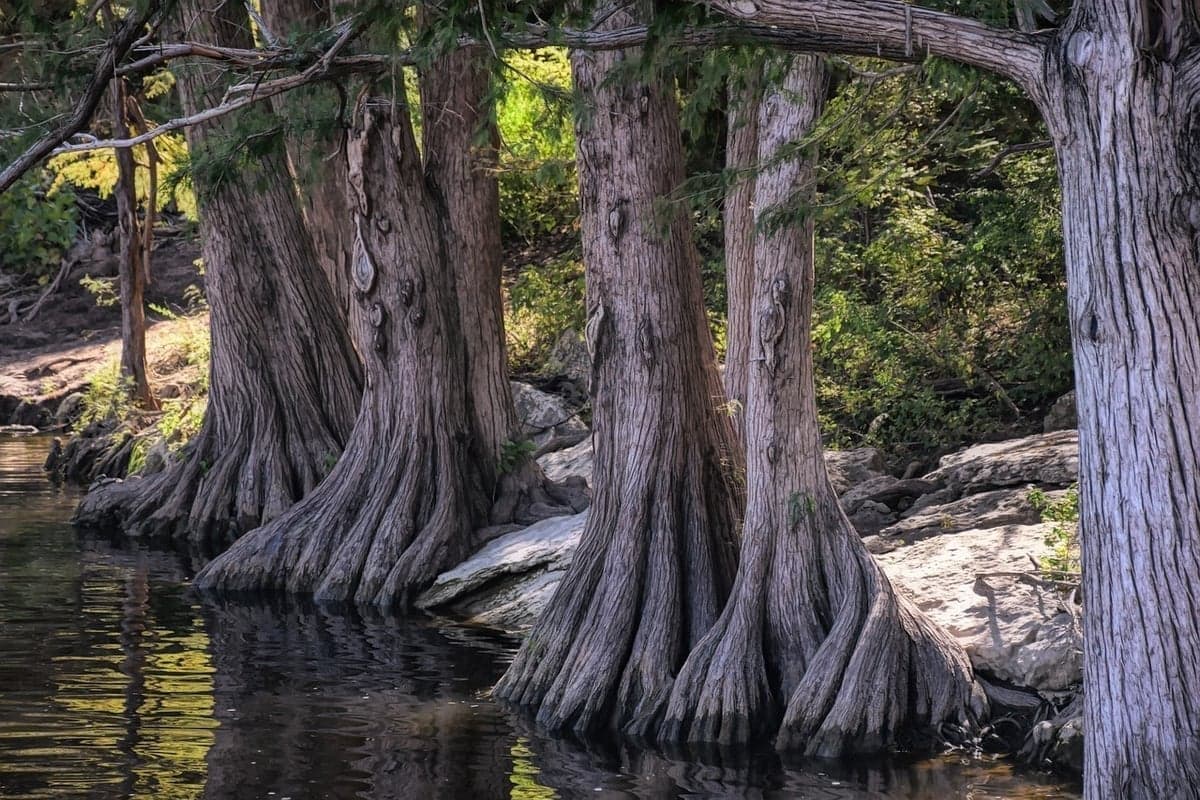
Bald cypress roots along a central Texas riverbank — a signature feature of Hill Country streams
Upper Guadalupe River (Above Canyon Lake)
Don't overlook the Upper Guadalupe above the lake. This freestone section flows through western Kerr County near Boerne, Comfort, and Spring Branch, with bald cypress-lined banks, limestone cliffs, and far less development than the trout tailwater below. The Upper Guad is a dedicated warmwater fishery holding Guadalupe bass, largemouth bass, carp, sunfish, Rio Grande cichlids, and gar.
Best approach: Topwater poppers thrown tight to shaded banks produce explosive strikes from bass. Baitfish and crawfish streamers work subsurface. The tree-lined canopy keeps summer days surprisingly comfortable.
Access: Guadalupe River State Park offers direct river access with no fishing license required from shore. Float trips with Lone Star Fly Fishing access the Upper Guad (half day $400, full day $600).
Flow note: As a freestone stream, water levels fluctuate with rainfall. Low-water periods can limit float trip options. Check RiverReports before planning.
South Llano River
The South Llano near Junction holds what biologists consider the best pure-strain Guadalupe bass fishery in the world. Between 2011 and 2017, Texas Parks and Wildlife stocked over 700,000 genetically pure Guadalupe bass here, and the population has thrived in these clear, spring-fed waters.
Target species: Guadalupe bass (primary), largemouth bass, Rio Grande cichlids, longear sunfish, catfish, gar, and carp.
What makes it special: The Guadalupe bass, nicknamed the "Texas Trout" for its willingness to take flies, is endemic to Central Texas. These fish hit topwater poppers, streamers, and crayfish imitators aggressively, especially in riffles and around limestone structure. The South Llano also sees remarkably little fishing pressure.
Access: South Llano River State Park provides 2,600 acres with 58 campsites and direct river access. No fishing license required when fishing from shore within the state park. The TPWD River Access lease at County Road 150 in Junction offers free bank fishing and boat launching.
Best seasons: March through June and October through November. Summer fishing is productive but hot; the cypress canopy provides welcome shade.
Flow windows:
- 40-80 CFS: Low but fishable on foot; excellent wading
- 80-150 CFS: Ideal for both wading and kayak floats
- 150-300 CFS: Good floating; wading limited to shallower riffles
- Below 30 CFS: Kayaks scrape; wade only
Float fishing: Kayak floats range from one hour to full-day excursions. Low water may require portaging through shallow sections. A pontoon or kayak with a shallow draft works best, pedal drives can hit rocks at lower levels.
Devils River
The Devils River is a bucket-list destination, one of the cleanest, most remote rivers in Texas, fed by springs that keep the water gin-clear year-round. Access is extremely limited; most of the river flows through private ranches, and multi-day expeditions require advance planning and physical fitness.
Target species: Largemouth bass, smallmouth bass (both catch-and-release only), carp (10-20 pound fish are common), catfish, and tilapia.
What makes it special: Sight fishing in turquoise water for bass and trophy carp, with zero cell service, dark-sky stargazing, and Native American rock art accessible only by river. This is wilderness fly fishing in a state better known for flat coastal waters.
Logistics: The standard trip is 4 days covering roughly 15 miles. Day 1 is the toughest, 6 miles of paddling plus portaging over the 15-foot cliffs at Dolan Falls. The Devils River State Natural Area requires a $10 access permit (DRAP). Book guided trips 5+ months in advance.
Outfitters:
Gear warning: Bring protective rod cases. Narrow, brushy channels routinely break rod tips.
San Marcos River
Spring-fed from the Edwards Aquifer, the San Marcos maintains remarkably consistent flows and water temperatures year-round. The crystal-clear water holds Guadalupe bass, largemouth bass, smallmouth bass, Rio Grande cichlids, and various sunfish species.
Access: Several TPWD River Access sites including San Marcos River Retreat, Scull Road Bridge Access, and River Grove provide free public fishing.
Best approach: Wade fishing with a 3-4 weight rod. Target riffles for Guadalupe bass and submerged timber for cichlids. The clear water demands stealth, soft casts and careful wading are essential.
Flow windows: The San Marcos typically runs 100-200 CFS year-round thanks to consistent spring flow from the Edwards Aquifer. It rarely blows out or drops to unfishable levels, making it one of the most reliable options for a last-minute trip.
Track San Marcos River flows on RiverReports for current conditions.
Llano River
The Llano and its forks offer miles of wadeable Hill Country water for Guadalupe bass, largemouth bass, and panfish. Multiple TPWD River Access sites. Pete's Pecan Patch, Castell Crossing, Maso-Llan Road, provide free bank fishing and boat launching along the river.
Flow windows:
- 150-300 CFS: Good wading in most sections
- 300-500 CFS: Ideal for kayak floats; wading possible in riffles
- 500-1,000 CFS: Float only; too deep and fast for safe wading
- Below 100 CFS: Very low; some sections too shallow for kayaks
Best seasons: Spring (March-June) and fall (October-November) produce the best fishing. Summer can be productive early and late in the day but water temperatures climb.
Blanco River
The Blanco flows through Hays County and holds Guadalupe bass, largemouth bass, Rio Grande cichlids, sunfish, and carp. John Knox Ranch River Access provides free public fishing. The Blanco is part of the active Guadalupe bass restoration program, with TPWD stocking genetically pure fish to rebuild populations.
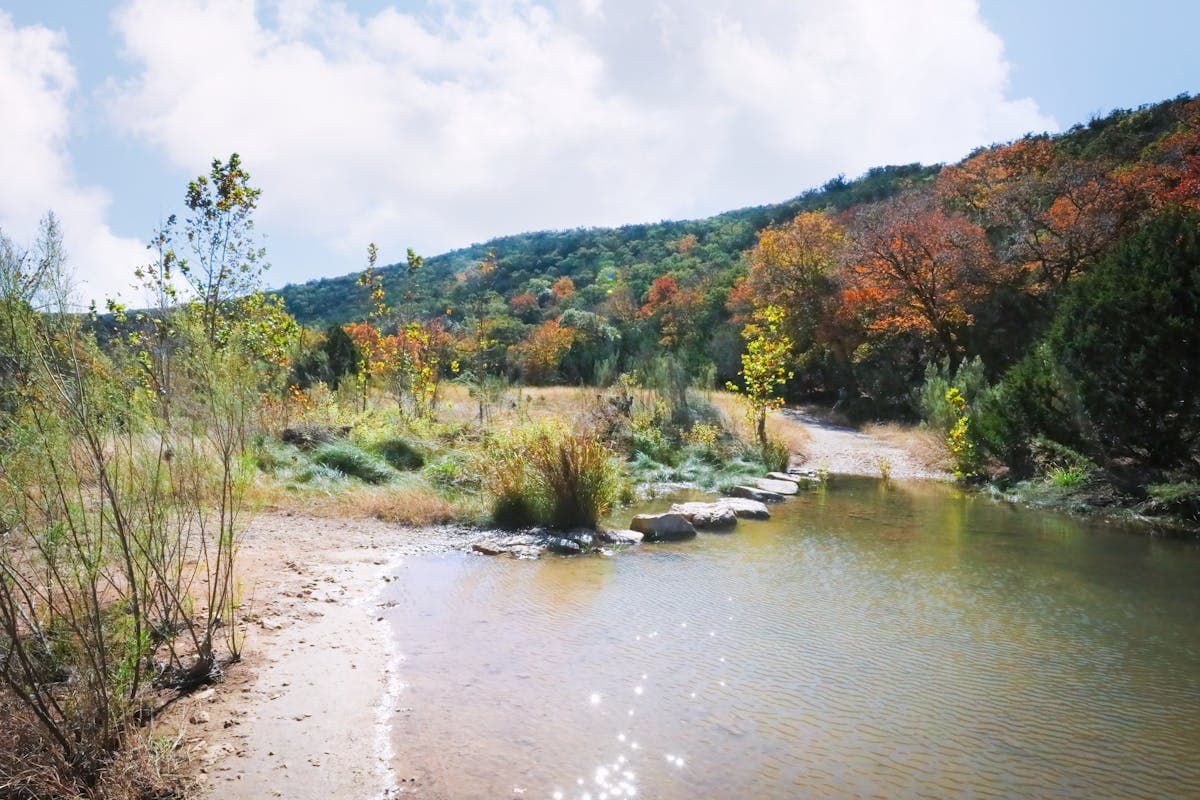
A peaceful Hill Country river scene — the kind of setting you'll find on the Llano, Blanco, and South Llano
Species Guide
Rainbow Trout (Guadalupe River)
Stocked November through March; holdover fish available year-round in the tailwater zone below Canyon Dam. The Guadalupe River hatch chart from Big Y Fly Co shows year-round insect activity:
Year-round patterns: Zebra Midges (#18-24, black/red/olive), San Juan Worms (#10-14, red), scuds (#12-18), Woolly Buggers (#4-12)
Spring through fall (Apr-Oct): Blue-winged Olives (#18-20), caddis (#12-16), Light Cahills (#14-16), Grey Drakes (#10-12), Tricos (#22-24), terrestrials (#6-16)
Summer peak (Jun-Aug): Hexagenia (#4-8), the largest mayfly on the river
Primary technique: Nymphing produces most consistently. A two-nymph rig with a midge dropper below a San Juan Worm or Pat's Rubber Legs covers most situations. Dry fly fishing during active hatches is excellent, particularly during BWO and caddis emergences.
Guadalupe Bass
The official state fish, found only in Central Texas streams. Guadalupe bass feed on crayfish, baitfish, and insects in clear, rocky riffles and runs.
Key flies: Topwater poppers (white, chartreuse), Clouser Minnows, crayfish patterns, wooly buggers in olive and black. Brighter colors tend to outperform on Hill Country streams.
Gear: A 4-5 weight rod with floating line handles most situations. For tight quarters under overhanging trees, a 7.5-8 foot rod improves accuracy.
Rio Grande Cichlids
The only cichlid species native to the United States. Found throughout Hill Country rivers: the Colorado, San Marcos, Guadalupe, Llano, and Blanco all hold good populations.
Key flies: Texas Freshwater Fly Fishing recommends five patterns: Pat's Hot Tail Mini-Craw, Modified Rio Getter, Jigged Foxy Clouser, Rio Poquito, and Deer Hair Ants. Fish small, cichlids have small mouths.
Technique: Cast tight to banks, logs, and rocks with soft presentations. Use slow, start-and-stop retrieves near the bottom. Repeat casts to the same cover, persistence triggers strikes more than perfect first presentations.
Gear: A 2-4 weight rod with a floating line and 6-7 foot leader with 3x-5x fluorocarbon tippet.
Where to Start
New to fly fishing or new to Texas? Start with the San Marcos or South Llano rivers for bass and panfish. Easy wading, forgiving fish, consistent flows, and free public access through state parks and TPWD leased sites. A 4-weight rod and a box of poppers and small Woolly Buggers will keep you busy all day. These rivers reward basic casting skills and don't require technical nymphing rigs.
Experienced fly anglers: The Guadalupe River trout zone is the main draw. If you're comfortable with two-nymph euro-style rigs, 6X tippet, and #20-24 midges, you'll find genuinely technical tailwater fishing. The key challenge is access, book a float trip or know which walk-in spots to hit (Action Angler, Guadalupe Park, Camp Huaco Springs). Winter weekdays offer the best combination of fresh stockings and light pressure.
Looking for an adventure? The Devils River is a legitimate wilderness expedition: physically demanding, logistically complex, and deeply rewarding. It's not a day trip. Plan for 4 days, bring your fitness, and book 5+ months ahead.
Regulations
Texas Parks and Wildlife manages all freshwater fishing regulations. Key rules for fly anglers:
License: Required for anglers 17 and older. Freshwater Package: $30 resident, $58 non-resident. One-Day All-Water: $11 resident, $16 non-resident. No fishing license required when fishing from shore within state parks.
Guadalupe River Trout Zones:
- Zone 1 (800 yards below Canyon Dam to FM 306): 12-18 inch slot limit, 5 trout daily (max one over 18"), artificial lures only
- Zone 2 (FM 306 to River Road second crossing): 18-inch minimum, 1 trout daily, artificial lures only
- Outside zones: No minimum length, 5 trout daily, no gear restrictions
Bass: Combined daily limit of 5 black bass (largemouth, smallmouth, Guadalupe, spotted). Largemouth and smallmouth require 14-inch minimum. No minimum for Guadalupe bass.
Sunfish, cichlids, carp: No bag or length limits.
Devils River: Smallmouth and largemouth bass are catch-and-release only. $10 Devils River Access Permit required for the State Natural Area.
Guided Trips
Half-day guided trips typically run $350-$525 for 1-2 anglers. Full-day trips run $500-$750. Most outfitters provide all gear: rods, reels, waders, flies, and lunch on full-day trips. A Texas fishing license is your responsibility.
Guadalupe River trout and Hill Country bass:
Premium lodge experience:
- Joshua Creek Ranch, 5-Star Orvis-rated sporting ranch near Boerne. Private stocked creek plus guided Guadalupe River float trips. Guided half day $425-$525, full day $625-$750. Orvis Fly Fishing School sessions from $339.
Devils River expeditions:
Seasonal Calendar
November - March (Trout Season): Peak fly fishing on the Guadalupe River. TPWD stocks rainbow trout from late November through early March. Water temperatures in the low 50s°F. Midges, San Juan Worms, and egg patterns dominate. January and February offer the best fishing with the freshest stockings and fewest crowds. Book guided trout trips by October, winter dates fill fast.
March - June (Spring Warmwater): Hill Country rivers come alive. Guadalupe bass feed aggressively in riffles as water warms. BWO and caddis hatches begin on the Guadalupe. South Llano River fishing peaks. This is the best window for combining trout and bass in a single trip.
June - September (Summer): Trout fishing winds down as water temperatures approach 70°F and ethical guides transition to warmwater species. The Guadalupe below Canyon Dam sees heavy tubing traffic from Memorial Day through Labor Day, hundreds of tubers daily on weekends make midday fishing futile. Fish at dawn or switch to weekdays. Bass fishing on Hill Country rivers remains strong, especially early morning and evening. Terrestrial patterns: hoppers, ants, beetles, produce well. The Hexagenia hatch on the Guadalupe (June-August) offers dramatic dry fly fishing if you beat the tube hatches. Devils River expeditions are comfortable despite heat thanks to spring-fed water temperatures.
October - November (Fall): Bass fishing peaks again on Hill Country rivers. Guadalupe River begins cooling toward trout-friendly temperatures. Excellent time for the South Llano and Llano rivers with low crowds and active fish.
Hazards and Considerations
Flash floods: Texas Hill Country rivers rise fast and dangerously after rain. A river at 100 CFS can spike to 10,000+ CFS within hours during a thunderstorm. Always check weather forecasts and current flows on RiverReports before wading.
Heat: Summer temperatures routinely exceed 100°F. Start early, carry plenty of water, and seek cypress shade during midday. Sun protection is not optional.
Private land: Nearly all Texas riverbank is privately owned. You can legally wade and float on navigable waterways, but you cannot exit onto private banks without permission. The streambed is public; the banks are not.
Cedar fever: Mountain cedar (Ashe juniper) pollinates December through February, prime trout season. If you have allergies, bring medication. Local guides will tell you this is no joke.
Zebra mussels: Draining all water from boats and receptacles is mandatory when leaving or approaching Texas public fresh waters.
Snakes and wildlife: Water moccasins are present on most Hill Country rivers. Watch where you step when wading and entering/exiting the water.
Frequently Asked Questions
Is Texas good for fly fishing?
Yes. Texas offers surprisingly diverse fly fishing, the Guadalupe River is the southernmost trout fishery in America, with stocking from December through March. Hill Country rivers like the South Llano and Llano produce excellent smallmouth bass year-round. And the Devils River is one of the most pristine backcountry fishing experiences in the lower 48. Track Texas river flows to time your trip.
Where can I fly fish in Texas?
Top spots include the Guadalupe River below Canyon Dam for trout, the South Llano and Llano rivers for Guadalupe bass and smallmouth, the San Marcos River for sight-fishing in crystal-clear spring water, and the Devils River for remote multi-day expeditions. Most of these are within 1-2 hours of San Antonio or Austin.
What is the best time to fly fish in Texas?
Trout fishing on the Guadalupe peaks December through March during stocking season, with holdover trout available through May. Bass fishing is best March through June and again October through November. The Devils River fishes well from spring through early fall. Check current Texas flows before heading out.
Using RiverReports
Track real-time flows for all major Texas fly fishing rivers on RiverReports. Key gauges to watch:
- Guadalupe at Spring Branch:Best gauge for the trout zone below Canyon Dam
- Guadalupe at Sattler:Upper trout section flows
- Guadalupe at New Braunfels:Lower river conditions
- Llano at Mason:Hill Country bass fishing
- San Marcos at San Marcos:Spring-fed consistency check
- Pedernales at Johnson City:Rainfall-dependent; shows Hill Country conditions
Compare current flows against seasonal averages to determine whether conditions favor wading, floating, or staying home. For the Guadalupe trout zone, 60-150 CFS means good wading; above 200 CFS, plan on floating.