
How Much CFS Is Too High to Wade? What the Gauge Won't Tell You
The gauge says 850. Whether you can stand up in it is a different question.
Greg Lamp
August 27, 2026
8 min read
You're in a gravel lot at 6am with the truck still running, looking at a gauge reading on your phone. It says 850 cfs. The question you actually have isn't what a cubic foot per second is. It's whether you can get across that thing.
CFS alone can't answer that, and anyone handing you a universal number is guessing. But there is a real answer, and it's learnable in an afternoon. (If you want the plumbing of what the unit means, we covered that in understanding river CFS flows. This is the other question.)
CFS Describes the Whole Channel, Not the Water Around Your Legs
CFS is a volume. It's the entire cross-section of the river, width times depth times speed, summed into one number at one location. That's genuinely useful for comparing a river to itself over time. It's close to useless for predicting what happens to your knees.
Spread 800 cfs across a 120-foot-wide flat and it's a shin-deep shuffle. Squeeze that same 800 cfs through a 30-foot canyon slot and it's a chute you have no business standing in. Same number, same second, opposite outcomes.
Your legs only feel two things: how deep the water is where you're standing, and how fast it's moving there.
The Rule That Actually Works: Depth Times Speed
Swiftwater instructors and wading guides use a simple product. Multiply water depth in feet by current speed in feet per second. As that number approaches 10, an average adult loses the ability to stand.
Fly Fish Mend puts it plainly: "Once the product of the velocity (feet per second) and the depth (feet) exceeds ten, you should not wade in that portion of a stream."
Ten isn't a magic constant. Laboratory work on human stability in moving water, reviewed by Jonkman and Penning-Rowsell in the Journal of the American Water Resources Association, found test subjects toppling across depth-velocity products of roughly 0.6 to 2 square meters per second, which converts to about 6.5 to 21.5 in feet. Ten sits in the conservative half of that spread. That's exactly where you want to be when the cost of being wrong is an unplanned swim in water that's still in the forties.
Run a few numbers:
- Knee deep (1.5 ft) at 5 ft/s: 7.5. Pushy, but most people hold.
- Thigh deep (2.5 ft) at 4 ft/s: 10. Right at the line.
- Waist deep (3 ft) at 3.5 ft/s: 10.5. Past it.
For reference, 5 ft/s is about 3.4 mph, roughly a brisk walk. So thigh-deep water moving at walking pace is about as far as most people should push. Water above your waist in any real current isn't wading, it's a swim you haven't agreed to yet.
Everything moves that line: body weight, boot soles, a staff, whether the bottom is packed cobble or greased bowling balls. Treat 10 as a ceiling you stay well under, not a target you walk up to.
Estimating Speed Without a Meter
Pace off 20 feet along the bank, toss a stick in at the top, and count. Twenty feet in four seconds is 5 ft/s. Twenty feet in ten seconds is 2 ft/s, which is nothing at wading depth.
Depth you probe with a wading staff before you commit a foot. That's most of what a staff is actually for. It reads the bottom ahead of you and gives you a third contact point when the current gets an opinion.
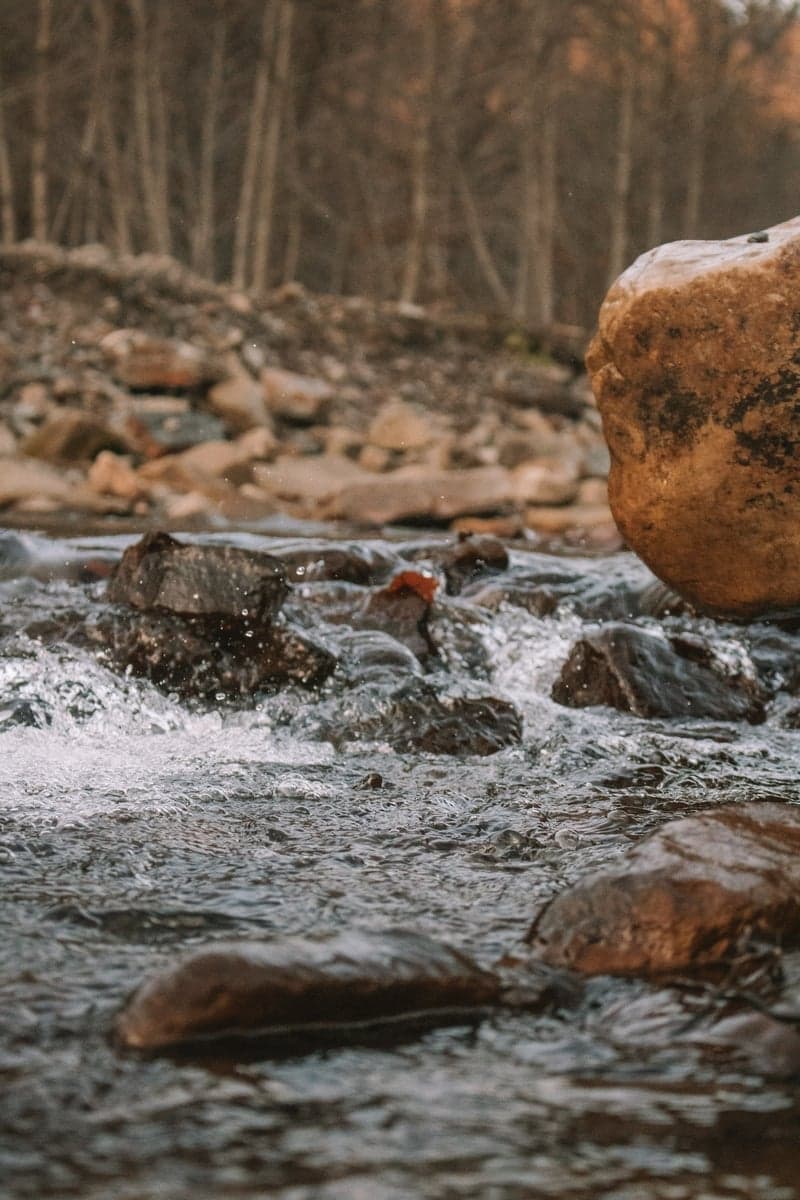
Shin-deep riffle at a slow walking pace: a depth-velocity product around 2, and about as safe as moving water gets.
Learn Your River's Number, Not a Universal One
This is where a gauge becomes useful again. You can't derive a safe wading depth from a CFS reading, but you can learn what a specific number means on a specific piece of water, and then that number works forever.
The ranges local shops publish are the fastest way in. At Deckers on the South Platte, Pat Dorsey puts the ideal window at 150 to 400 cfs. On the Arkansas near Salida, local guidance is that the section "fishes best between 225 and 400 cfs for wading. Above that, stick to the edges or float it."
Head to Montana and the numbers triple. Montana Angler notes that the boulder-strewn Slide section of the Madison below Quake Lake "is difficult to fish until it drops below 1,300 cfs." Same activity, same body, four times the volume.
Back east, the Ernest Schwiebert chapter of Trout Unlimited maps the West Branch of the Delaware in detail: nearly fully wadable at 400 to 450 cfs, roughly 60 to 70 percent wadable at 600 to 800, minimal wading above 1,200, and a flat "too high and too dangerous" above 1,500.
Now go small. On Boulder Creek, 40 to 80 cfs is the sweet spot for fishing, and the county sheriff has closed it to tubing outright at flows around 700 cfs. Seven hundred is a routine wading day on the Madison and a public safety closure on Boulder Creek. Track a few of these on the Colorado and Montana flow pages and you'll build your own table in a season.
Watch the Trend, Not the Snapshot
A river at 800 and rising is not the same animal as 800 and falling, even though the gauge says the same thing.
Rising water is pushier, dirtier, and carrying debris. You can't see your feet, the bottom is being rearranged as you stand on it, and the number you checked in the parking lot is already stale. Falling water is doing the opposite on all three counts.
Then there's the median. Every flow chart worth reading shows the historical typical flow for that date. A river at twice its median in August is not the river you fished in August last year, no matter how familiar the name is.
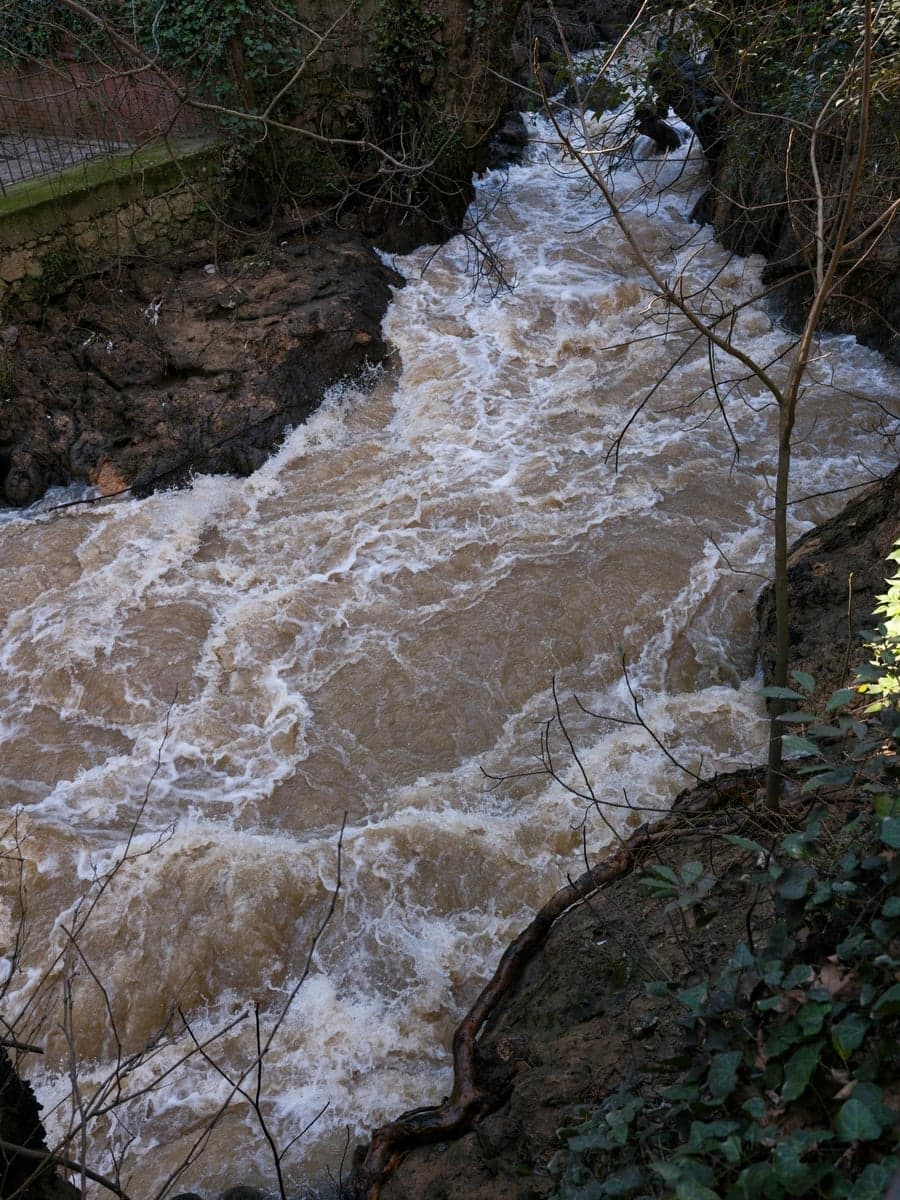
Rising and off-color. The gauge number matters less than the direction it is moving.
Two Things the Gauge Won't Tell You
Stage is often the better number. Gauge height, reported in feet, tracks depth at the station directly. For wading purposes that maps to your legs more intuitively than volume does. If your river reports both, learn the stage. Plenty of anglers never look at CFS again.
The gauge isn't where you're standing. It might be twenty miles downstream with three tributaries and a diversion in between. A thunderstorm dumping on one drainage can double your crossing while the gauge below still reads normal. Freestone rivers swing hardest here, which is part of why freestones and tailwaters demand different habits.
The Part That Actually Hurts People
Nobody drowns because they misread a CFS number. They drown because they were already committed when the water got a vote.
Crossing is the dangerous half. A wade in at 7am on a tailwater can be a genuinely bad wade back at 11am after the dam ramps up, and you'll be tired, cold, and standing on the wrong bank. Plan the return before you commit to the trip out.
Soles matter more than most anglers admit. Felt grips algae-slicked rock in a way plain rubber does not, though studs and cleats narrow that gap considerably and rubber travels between watersheds without hauling invasive species with it. Bare rubber on green rock is the worst combination in this sport.
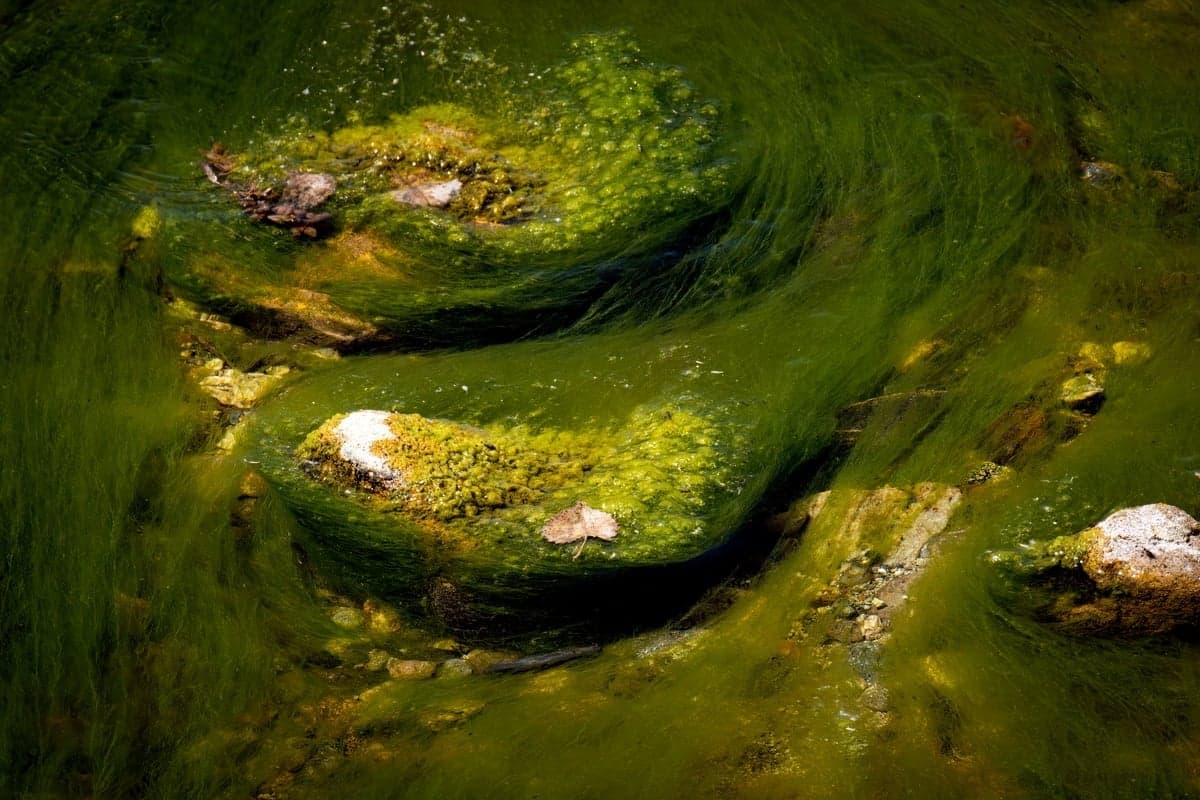
Algae-coated rock. This is where bare rubber soles quit working, at any flow.
Cinch the wading belt. Go in with it snugged up and the water stops at your waist, leaving air trapped in your legs to float you until you reach shallower water. Go in without it and your pant legs fill, which takes away the leg motion you need to swim. Unbuckle your sling or chest pack before you step in so you can shed it fast, and carry a staff any time you'll be in water consistently past your knees.
If You Go In
Get on your back with your feet downstream and your toes at the surface. Feet first means your legs absorb the rocks instead of your head, and keeping them up is the whole point: standing in current is how feet get wedged and how people drown in water they could have floated out of.
Don't stand until you're in water below your knees or out of the current entirely. Backstroke at an angle toward the bank you want. Don't fight upstream.
The National Park Service's advice for swift water is blunter than any of this, and worth holding onto when you're talking yourself into a crossing: you do not know how deep or how fast that water is flowing.
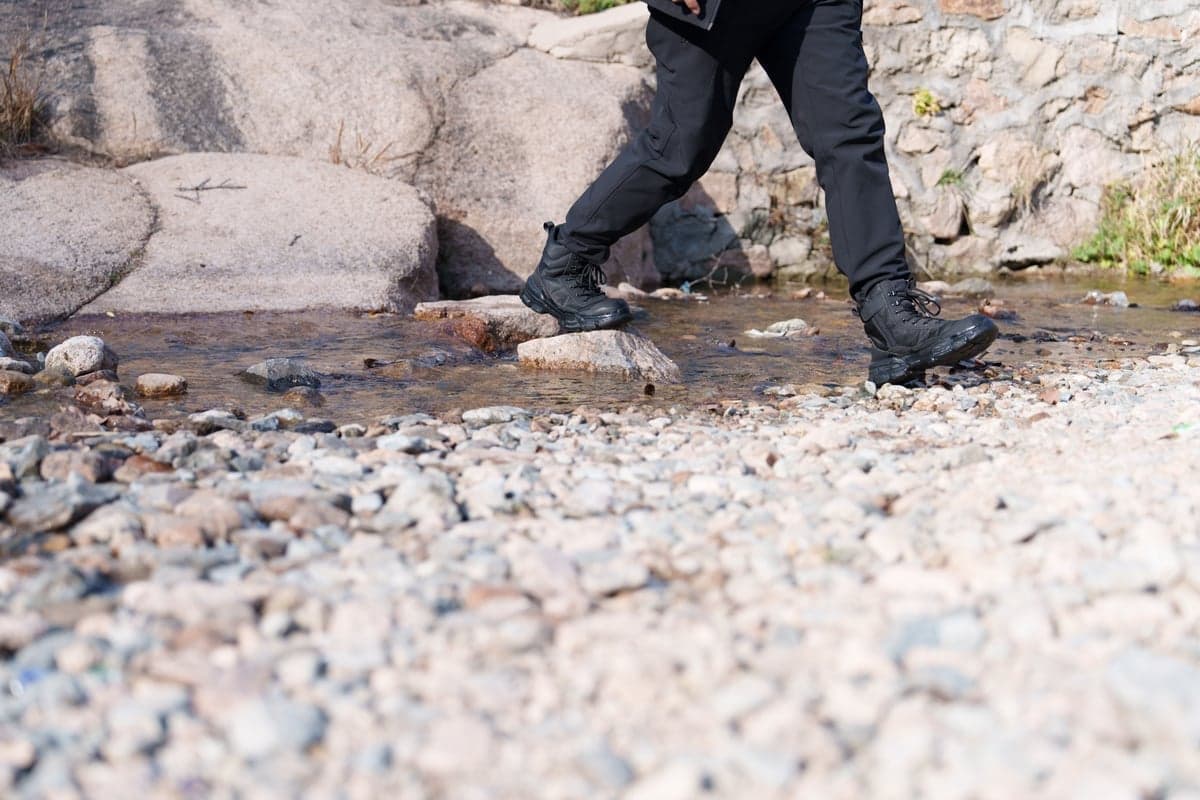
Probe with the staff, shuffle, never cross your feet, and pick the exit before you start.
Making the Call
The gauge won't tell you whether you can wade. It will tell you whether today is normal, whether the river is coming up or going down, and how it compares to the days you already know. That's most of the decision.
The rest happens at the water's edge with a stick and a count. If depth times speed is anywhere near 10, you're done, and the fish on the far bank will still be there next week.
Pull up your home water on the Colorado, Montana, or Idaho flow pages, find the median line, and start writing down what each number felt like underfoot. After a season you'll glance at the gauge and know.
Get River Intel Weekly
Flow updates and fishing intel delivered every Thursday.
River Intel Weekly
Weekly flow updates and fishing intel.
© 2026 RiverReports, Inc.