Eleven Mile Canyon
Marginal
Flow~69 CFS
Trendstable
Clarityclear
TempUpper 50s to low 60s F
Organza Trico Spinner #18-22Parachute Adams #20-26Mole Fly #20-22Elk Hair Caddis #16
| What | When | Key Numbers |
|---|---|---|
| Productive flows | Year-round | 75-200 CFS ideal; over 300 CFS gets tough |
| Quality Water (C&R) | Year-round | 3.8 miles, dam down to Wagon Tongue Gulch Rd bridge |
| Forest Service fee | Year-round | $11/vehicle day use; $100 annual site pass |
| Camping | Mid-May to mid-Oct | 4 campgrounds, $24/night; 3 reservable, Riverside is first-come |
| Winter midges | Nov-Mar | Road usually open; #22-26 patterns; fish 11am-2pm |
| Trico mornings | Mid-Jul to Oct | #24-26 duns and spinners, first light to 9am |
| Fly shop | Angler's Covey | (719) 471-2984, 295 21st St, Colorado Springs |
| Fly shop | South Platte Fly Shop | (719) 686-8990, 405 E Hwy 24, Woodland Park |
Eleven Mile Canyon is the South Platte beat you can fish without earning it first.
That is not a knock. The upper South Platte has three famous sections, and each one asks something of you before it gives anything back. Cheesman Canyon wants a mile and a half of trail and a willingness to fish 7X in gin-clear water. The Dream Stream wants you to time the migration windows correctly and then share them with everyone else who did. Deckers is easier to reach but sits closest to Denver and takes the pressure that comes with that.
Eleven Mile Canyon has a road running down the middle of it. Nine miles of dirt track follows the river from the town of Lake George up to the base of Eleven Mile Reservoir Dam, and along the way there are pullouts, four picnic areas, four campgrounds, vault toilets, and three old railroad tunnels blasted through the granite. You can park, take ten steps, and be standing in a productive tailwater.
What you should not conclude is that the fishing is easy. Colorado Parks and Wildlife estimates roughly 1,305 trout six inches or longer per mile in the Quality Water section, and those fish have been educated by a road's worth of anglers. What the canyon gives you is access, not charity. You still fish small flies and fine tippet. You just do not hike to get there.
Which makes this a logistics page more than a technique page. It is ordered the way you will actually use the canyon: what it costs to drive in, where you sleep, then which of the nine miles to stand in.
From Colorado Springs, take US-24 west roughly 37 miles to the community of Lake George, then turn south on County Road 96 and follow it about two miles, veering right at the fork. That puts you at the canyon entrance. Angler's Covey lists the drive as about 46 minutes from their shop. From Denver, budget closer to two hours via US-285 and US-24.
Once you turn into the canyon, the pavement ends. Forest Road 245 is a graded dirt and gravel road that follows the river for about nine miles to Spillway Campground at the base of the dam. A passenger car handles it fine in dry conditions. It is narrow, dusty in summer, washboarded in places, and shared with campers, trailers, cyclists, and people driving slowly to look at the walls. Plan on 25 to 30 minutes to drive the full length, and more if you stop. Drive it expecting to meet an RV coming the other way around a blind corner, because eventually you will, and in winter expect ice in the shaded stretches where the sun never reaches the roadbed.
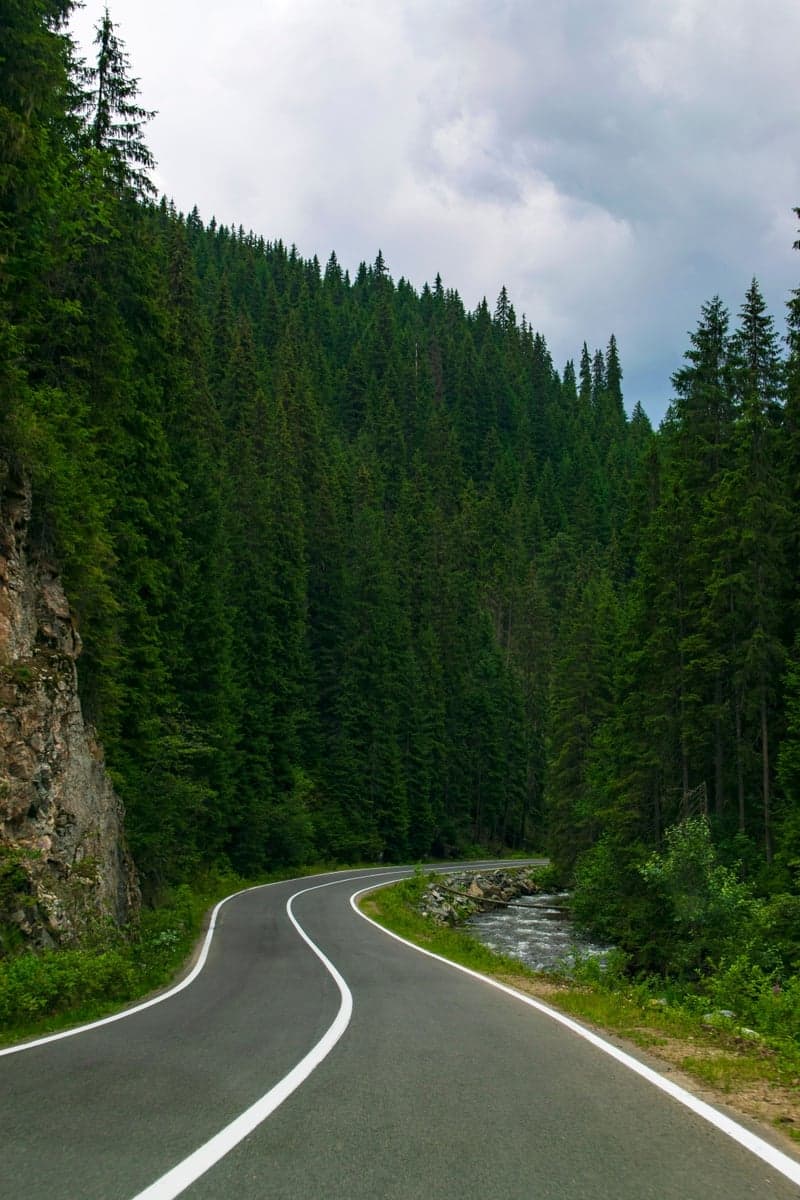
A paved two-lane through mountain forest, which is what the US-24 approach looks like. Do not picture this once you turn south at Lake George: the canyon road itself is nine miles of graded dirt with no centerline and no shoulder.
Eleven Mile Canyon is a US Forest Service fee area inside Pike National Forest. Per the Forest Service recreation area page, the day-use fee is $11 per vehicle, $25 for a bus or van carrying 10 or more passengers, and $100 for a site-specific annual pass. If you are camping, the $11 covers the duration of your stay rather than being charged daily. Fees get revised, so check that page before you budget the trip.
The entrance station is staffed seasonally during daylight hours. Outside those hours you pay at a self-service fee tube, and the Forest Service lists accepted payment as cash, check, or money order, so do not count on a card working. Senior and Access pass holders get 50% off concessionaire campsites.
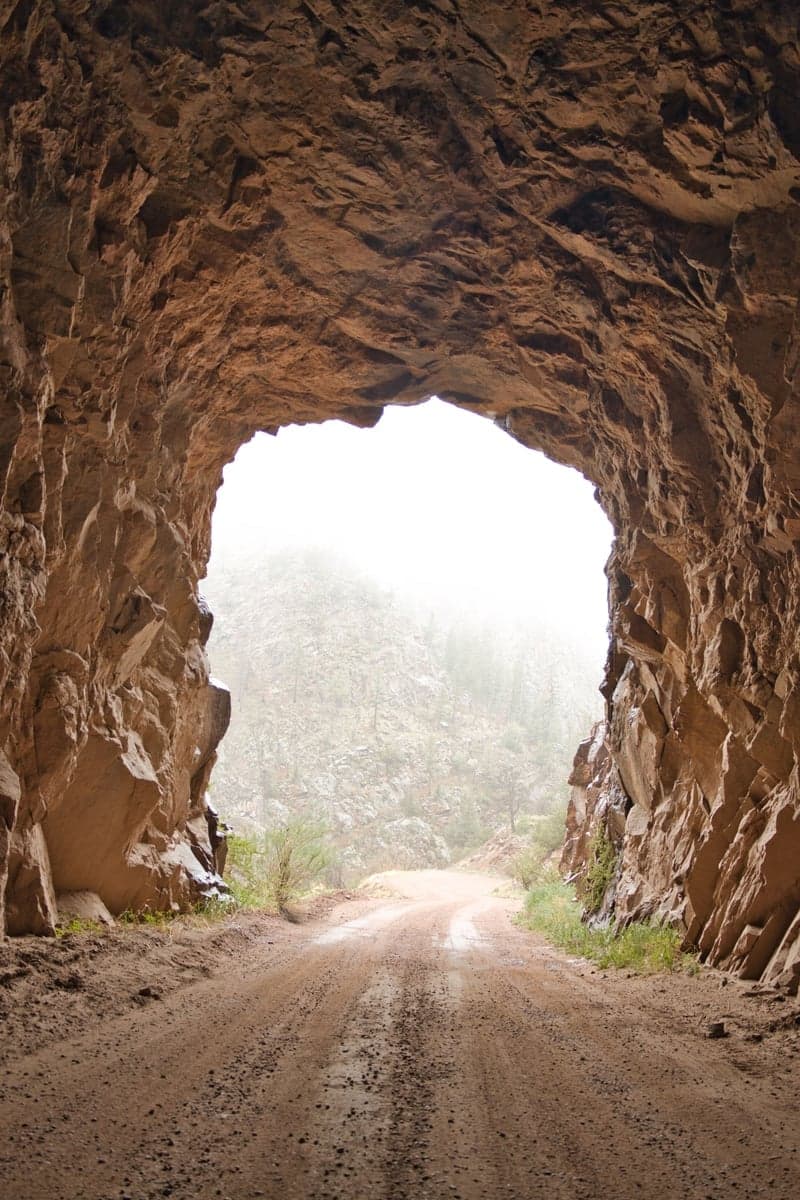
The road exists because the Colorado Midland Railroad got there first. The first Midland passenger train ran up this canyon in 1887, back when it was called Granite Canyon, and the roadbed you drive today is the old grade. Three rock tunnels remain, cut straight through the granite. They are narrow, single-lane in practice, and unlit. Slow down, turn your headlights on, and look up as you pass through: the ceilings still carry soot from steam locomotives.
Bring your own drinking water. There is no potable water as a general service in the canyon, though the campgrounds have hand pumps. Dispersed camping is prohibited inside the canyon, so a pullout is not a legal place to sleep. And the canyon floor sits between 8,000 and 8,500 feet, which is high enough that anyone who woke up near sea level will feel the climb back to the car in waders.
Camping is a genuine reason to come here rather than a footnote, and it changes how you fish the place. Staying in the canyon means you are on the water for the Trico spinner fall at 7am and the evening caddis at dusk without a two-hour drive bracketing your day. Everything else about this fishery, the flows, the fly sizes, the crowds, is easier to solve from a tent 200 feet from the river.
Four Forest Service campgrounds sit along the river. Site counts, seasons, and fees below come from the Forest Service pages for each one:
| Campground | Sites | Elevation | Booking | Notes |
|---|---|---|---|---|
| Riverside | 18 (11 walk-in) | 8,000 ft | First-come, first-served | Lowest in the canyon; trailers to 30 ft |
| Springer Gulch | 15 | 8,300 ft | Reservable | Near the Quality Water boundary; trailers to 25 ft |
| Cove | 4 | Mid-canyon | Reservable | Smallest and quietest; books out fast |
| Spillway | 23 | 8,500 ft | Reservable | End of the road, below the dam; closest to the C&R water |
All four have picnic tables, fire rings, vault toilets, and a hand pump for drinking water. None have hookups. The Forest Service lists $24 per site per night, with two vehicles or one RV included and $11 for a third vehicle. Check-in is 2pm and checkout is noon.
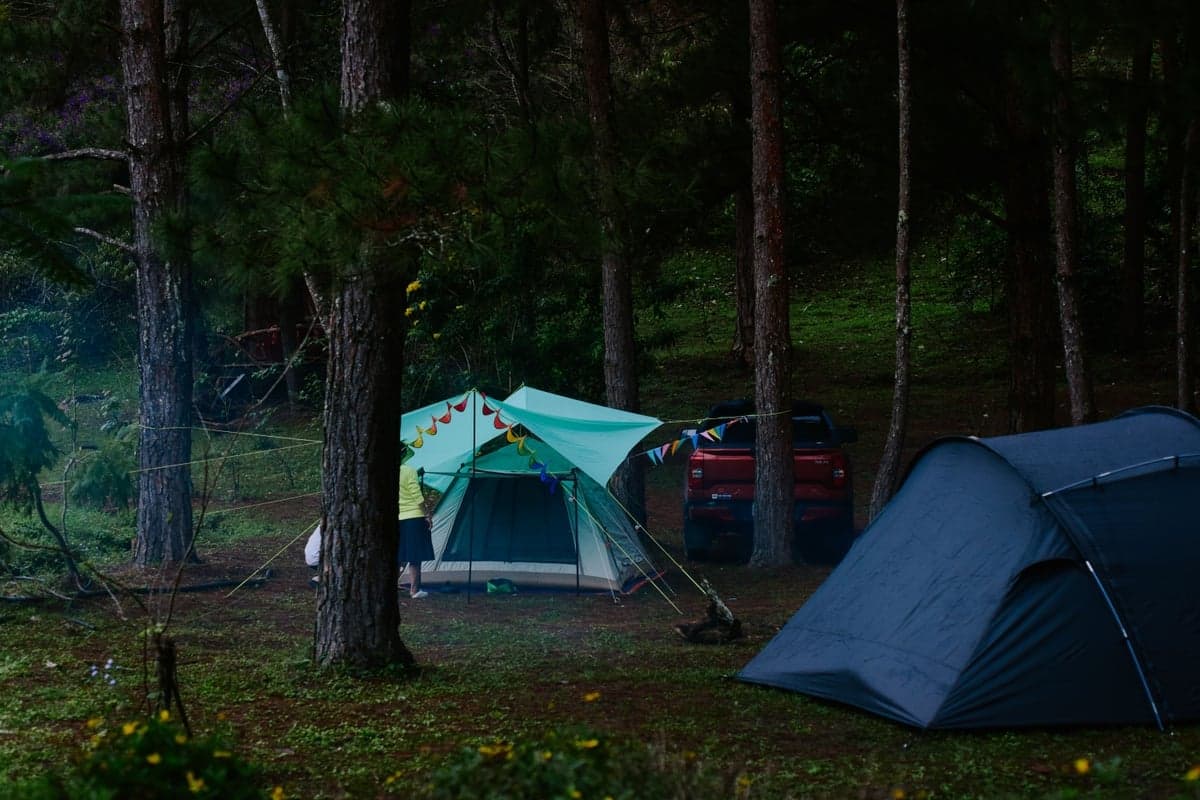
Tents and a vehicle at a drive-in site among pines. Four Forest Service campgrounds line Eleven Mile Canyon, and Spillway sits at the very end of the road below the dam, which puts you closest to the catch-and-release water.
Season is mid-May to mid-October, weather dependent, with Cove opening slightly earlier in early May. Riverside is first-come, first-served and must be occupied the same night you claim it, so do not plan a trip around getting a site there on a summer weekend. The other three book through Recreation.gov or 877-444-6777, at least four days and at most 180 days ahead. Reserved sites carry minimum stays on Friday and Saturday nights and a three-night minimum on holiday weekends; walk-ups are exempt from those minimums. Maximum stay is 14 nights.
Fire restrictions come and go. A Stage 1 prohibition has been in effect for the 2026 late season, limiting open fires to Forest Service-maintained rings. Check current restrictions before you pack a firewood bundle.
If the canyon campgrounds are full, Eleven Mile State Park sits on the reservoir above the dam with a much larger campground inventory. It requires a separate state park pass, and it is a windier, more exposed place to sleep.
The canyon is not one fishery. There is a real gradient from the dam down to Lake George, and because you are choosing a pullout rather than a trailhead, that choice is the main decision you make all day.
This is the coldest, most stable water in the system, with the deepest slots and the highest fish densities, and it almost never freezes in winter. It is also the most technical water in the canyon. The current is smooth, the fish are used to being cast at, and presentations have to be clean. On a hot August afternoon this is the section that keeps fishing after the rest of the canyon goes quiet.
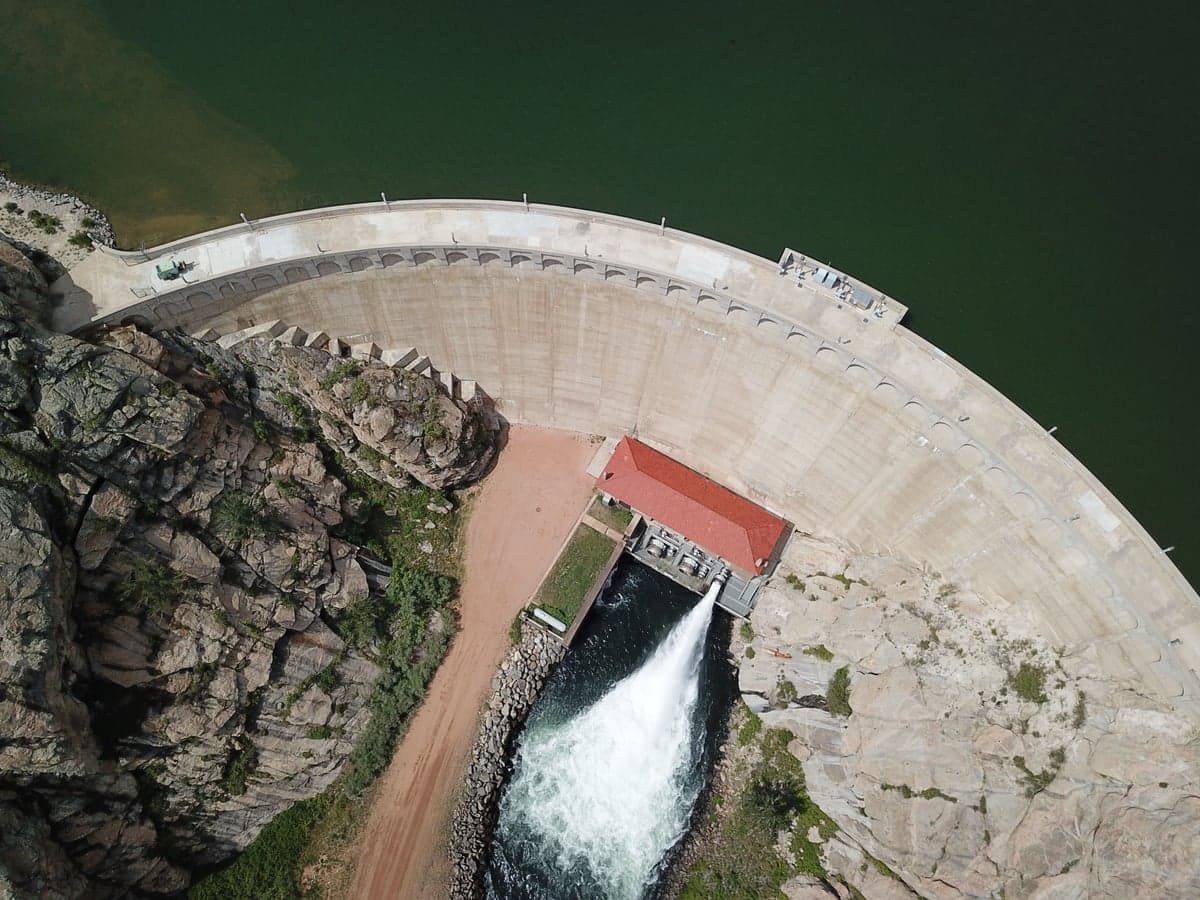
A concrete arch dam releasing water into the canyon below it. Eleven Mile Dam stands 135 feet and draws from near the surface, which is why the canyon warms faster in late summer than a deep bottom-release tailwater.
Roughly from Springer Gulch down through Cove and the picnic areas, the river mixes deep holes, riffles, mid-channel shelves, and genuinely good pocket water. Granite boulders break the current constantly and create small, obvious lies. This is the friendliest water to read and the easiest to wade, and it is where a competent but not expert angler is most likely to hook something. Casts of 15 to 25 feet into pocket water do more work here than long-distance presentations.
Down here the canyon opens up. Wading gets easier, the gradient softens, and there are fewer trout per mile, especially in summer when the water is noticeably warmer. It fishes better in spring and fall than in July and August. One note: Camp Alexander, a Boy Scout facility roughly a mile into the lower canyon, is private and closed to public fishing. Watch for the signs.
The boulders in this canyon have been scoured smooth, and they are slicker than they look at every flow. Felt soles grip them better than rubber does. A wading staff earns its place here, particularly once the river is over 200 CFS and the pocket water starts pushing.
Come to Eleven Mile Canyon if:
Go somewhere else if:
For the bigger picture on how these sections fit together, the South Platte River guide covers the drainage as a whole, and the Denver Front Range guide puts it in context with the rest of the metro-accessible water.
Two sets of rules apply, and the line between them is a bridge.
Quality Water, 3.8 miles: from immediately below Eleven Mile Reservoir Dam downstream to the Wagon Tongue Gulch Road bridge at Springer Gulch. Artificial flies and lures only. All trout must be returned to the water immediately. This is the stretch most people mean when they say "the canyon."
Below the bridge to Lake George: standard statewide trout regulations apply. Most anglers release fish here anyway, but the rules do not require it.
One point of confusion worth clearing up, because several fly shop pages get it wrong: Eleven Mile Canyon is a CPW Quality Water, not Gold Medal water. Gold Medal is a separate designation for waters that sustain 60 pounds of trout per acre with a meaningful share of fish over 14 inches. The South Platte carries about 37 miles of it, spread across five reaches:
Read that list geographically and the point makes itself. Gold Medal water runs down through South Park and stops at Eleven Mile Reservoir, then picks back up below Cheesman Dam. Eleven Mile Canyon sits in the gap between the two, which is exactly why it is not on the list. The canyon is a strong fishery either way and the practical rules are the ones above, but if you are choosing a destination based on the designation, know which one you are actually looking at.
You need a valid Colorado fishing license plus the Forest Service day-use pass. Regulations get revised, so confirm the current boundaries and limits in the CPW brochure before your trip rather than trusting a page you read six months ago.
One more rule that is not a regulation but should be: New Zealand mud snails are established in this water. They travel in wading boots and gear, and they spread to other rivers when you do. Clean and dry your gear between waters. Felt soles are still legal in Colorado, and they grip the polished granite here better than rubber, but they are also the worst offender for moving invasives, so decontaminate seriously if you use them.
Eleven Mile Canyon runs on releases from Eleven Mile Reservoir, which is part of the Denver Water system and sits below Aurora Water's Spinney Mountain Reservoir. That gives the canyon steadier flows than a freestone, but the numbers still swing with reservoir operations and downstream demand rather than with the weather in front of you.
| Condition | CFS Range | What to Expect |
|---|---|---|
| Very low, technical | 30-70 | Glassy water, spooky fish, 7X and long leaders. Winter baseline. |
| Productive | 75-200 | The band you want. Good wading, readable water, active fish. |
| High but fishable | 200-300 | Fish spread out, presentations get more forgiving, wading gets harder. |
| Difficult | 300+ | Fishing falls off sharply. Wading marginal to unsafe in places. |
Typical seasonal baselines: winter around 30 to 60 CFS, spring 80 to 120, summer 150 to 250 depending on releases, and autumn back down to 50 to 100. Below about 100 CFS in the fall, dry fly presentations get genuinely hard because the surface goes flat. The gauge that drives all of this sits near Lake George at the bottom of the canyon, so it reflects the whole canyon's flow rather than just what is leaving the dam.
The temperature story is the one most guides get wrong on paper. Eleven Mile Reservoir releases from near the surface rather than from deep in the water column. In late summer that means warmer, nutrient-rich water entering the canyon, which is why the bug life here is so dense and also why afternoon water temperatures can climb into the mid-60s in August. A stream thermometer is the cheapest thing in your vest. If the water is pushing 67 degrees, go do something else, or move up to the shaded water immediately below the dam.
Rainbows, browns, and cutbows, with most fish running 12 to 17 inches and a real chance at something over 20. A CPW aquatic biologist reported densities as high as 184 fish over 14 inches per acre alongside that estimate of 1,305 trout six inches or greater per mile in the Quality Water. Those are strong numbers for a section you can reach in flip-flops.
Where Eleven Mile differs honestly from Cheesman is the stocked-versus-wild question. Cheesman is all wild with no stocking. Eleven Mile gets both: CPW has put more than 37,000 trout into this section since 2020, with an emphasis on whirling-disease-resistant rainbow strains, and this is also one of the few places in the South Platte drainage where rainbows reproduce successfully in the wild, which CPW attributes in part to how Aurora Water and Denver Water manage flows here. You are fishing over a genuine mix. That is a feature if you want to catch fish and a caveat if wild-fish purity is what you drove out for.
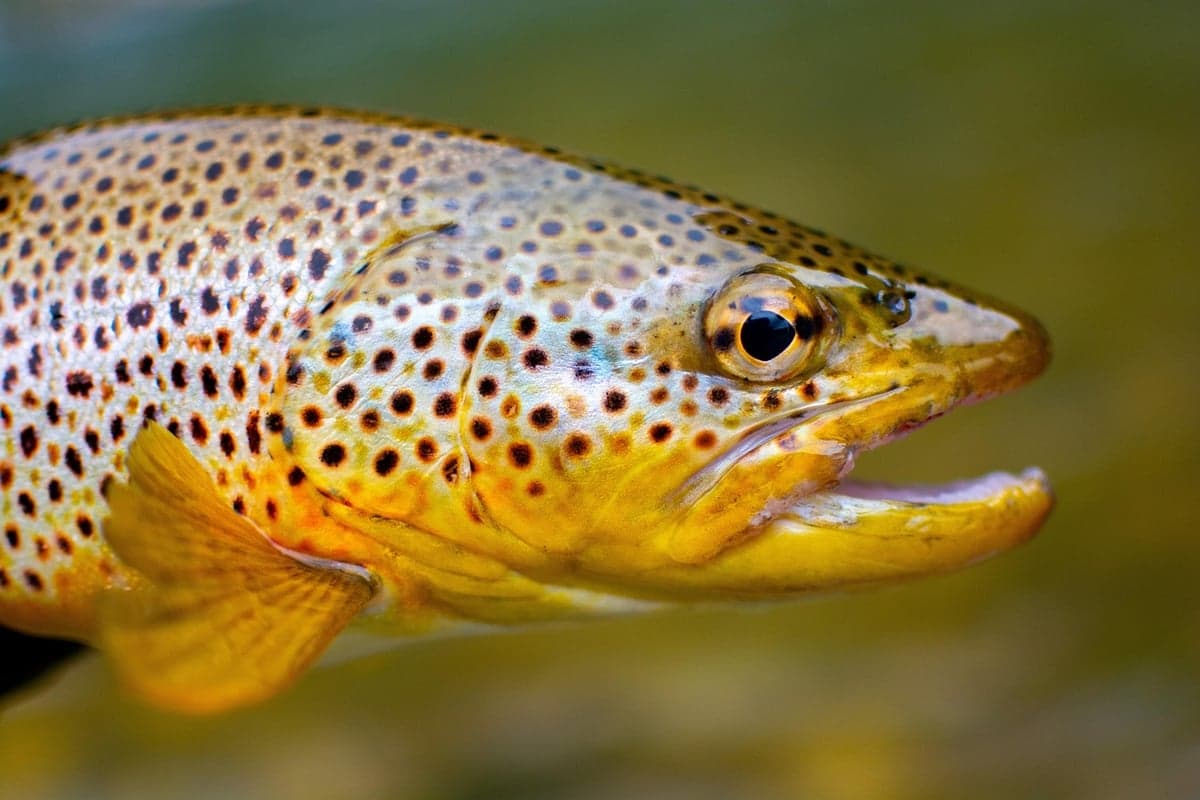
A brown trout held in the water, gold flanks and black and red spotting. Fish in the Quality Water go back immediately, so wet your hands, keep the fish wet too, and skip the photo if it is fighting you.
The canyon road is generally open through the winter. Forest Service services are reduced, snow and ice can make the dirt road genuinely hazardous, and you should check conditions first, but the gate is not locked in November. That is unusual, and it matters, because tailwater below a dam does not freeze the way a freestone does. The first mile below Eleven Mile Dam rarely ices over at all.
From November through March the trout eat midges almost exclusively. Fish #22-24 patterns: Mercury Midge, Top Secret Midge, Black Beauty, Mercury Blood Midge. Flows drop to 30 to 60 CFS, which means glassy water and fish that see everything, so 7X fluorocarbon and a 12-foot leader are not optional.
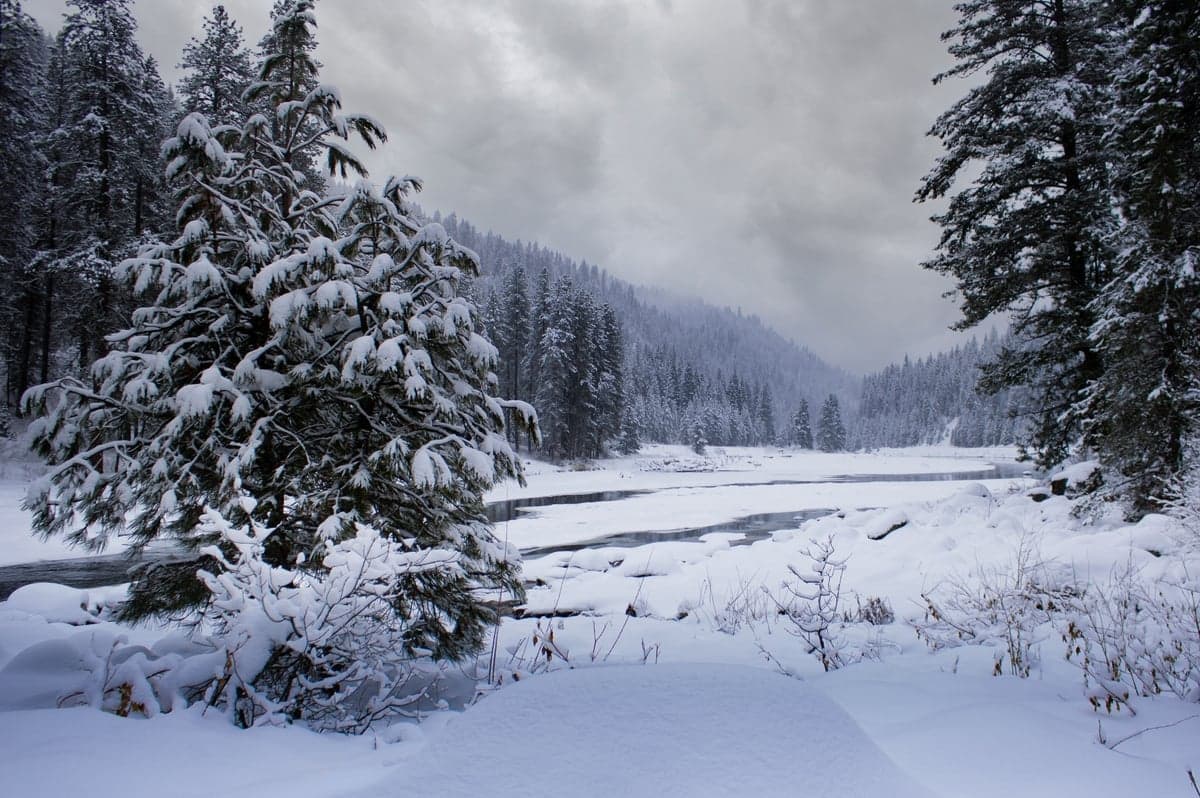
The road stays open through winter and the water below the dam rarely freezes. Fish the 11am to 2pm window when the water warms a couple of degrees.
December and January are the hardest months, and the useful discipline is sorting the fish you can see. You will spot far more trout than are actually eating. The ones worth casting to are suspended in the current column and moving side to side; the bottom-huggers sitting motionless are not going to eat. Ignore them and spend your hour on the movers.
By February, midges hatch for several hours in the middle of the day and you can genuinely get dry fly fishing on a #24-26 Griffith's Gnat or Matt's Midge. Concentrate on the 11am to 2pm window when water temperatures nudge up a degree or two. Bring more layers than you think, because the canyon walls keep the sun off the water for much of a short winter day.
BWOs start in March and build through April into the most reliable hatch of the first half of the year. Fish a Sparkle Wing RS2 #20 or a Mercury Flashback Pheasant Tail #20 ahead of the hatch and switch to a small parachute BWO once noses show. Yellow Sallies begin in early May, and afternoon caddis start showing late in the month. Flows typically sit in the 80 to 120 range, which is comfortable water to fish.
Pale Morning Duns start in mid-June. Tricos come on around mid-July and run into October, producing dense dun hatches at first light followed by spinner falls that will have every fish in a pool eating. Hoppers work along the grassy banks through August. The summer complication is heat and company: the canyon fills with campers and climbers on weekends, and afternoon water temperatures can get uncomfortable for the fish. Fish early, fish the upper canyon, carry a thermometer.
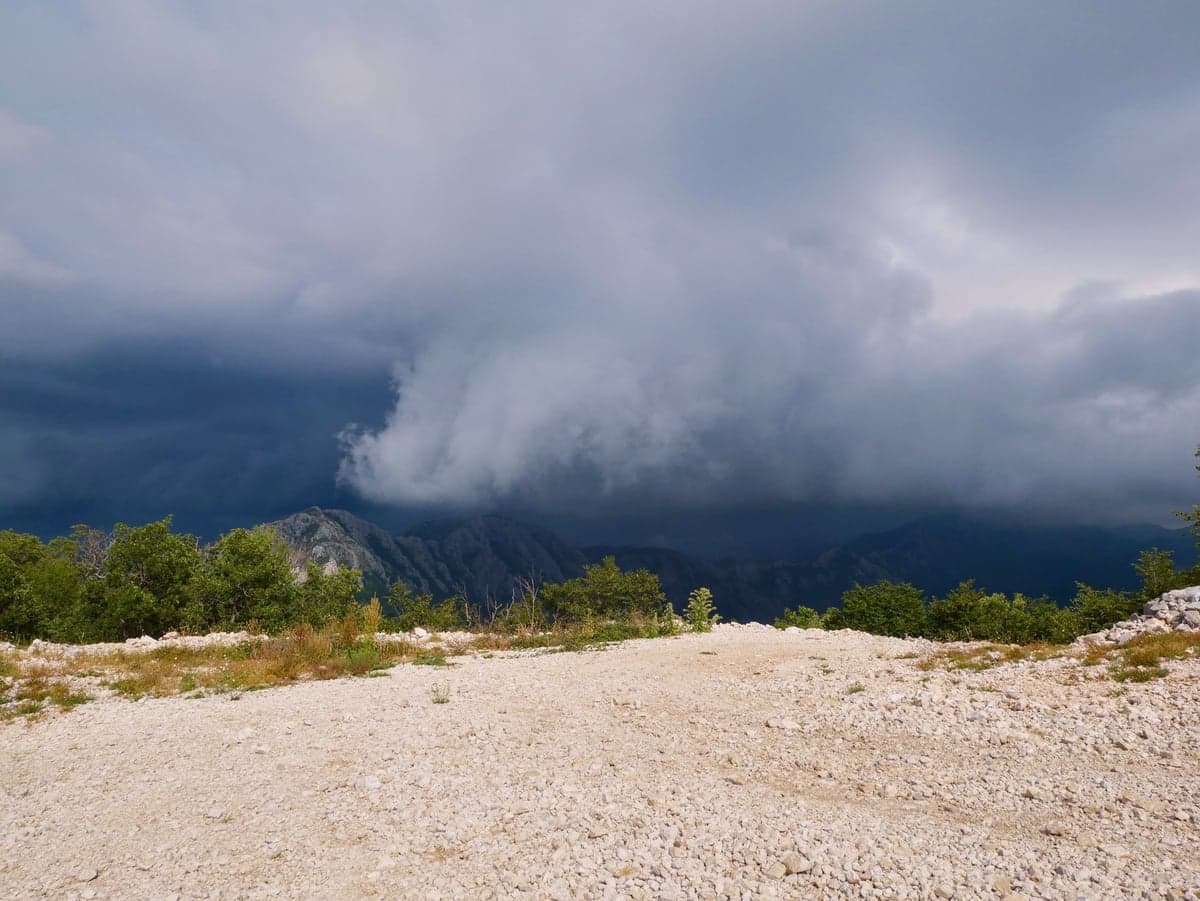
A storm building over open high country. South Park generates these in an hour on a July afternoon, and the canyon gives you a granite slot with nowhere sheltered to go. Reel up at the first thunder rather than the third.
BWOs return heavily, Tricos hang on into October, and the summer recreation crowd thins out substantially. Flows drop into the 50 to 100 range, which makes dry fly work technical but rewarding. Browns start spawning in late October; watch for redds in the gravel and walk around them rather than through them. Egg patterns fished below active redds produce well, and there is a reasonable argument for leaving spawning fish alone entirely.
The Pikes Peak granite domes here are a legitimate climbing destination, with sport routes, some trad, and bouldering across a wide difficulty spread, from The Staircase (5.5, two pitches on Arch Rock) to routes at 5.13b. At around 8,500 feet the rock stays cool while lower crags bake, which draws summer traffic. Pikes Peak Alpine School guides in the area.
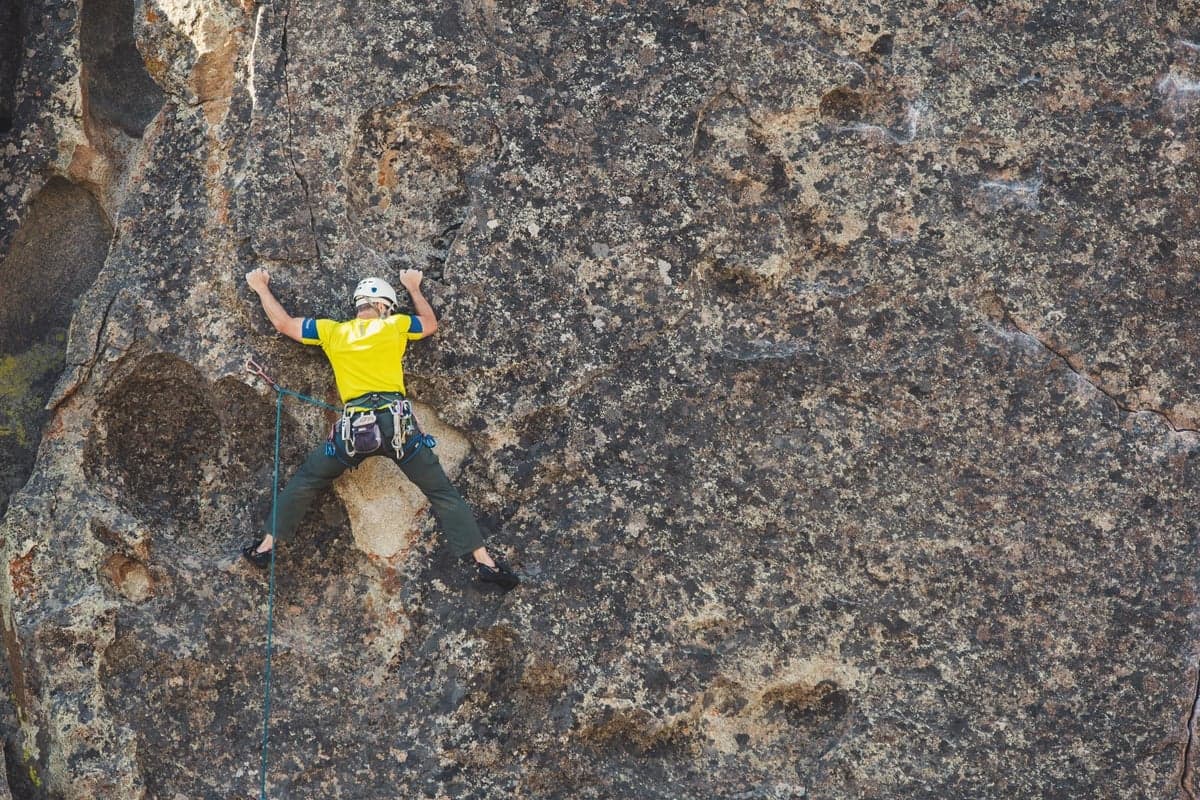
A roped climber working a bolted line on lichen-covered granite. Eleven Mile's domes draw climbers all summer, so expect company at the pullouts and give anyone below a route plenty of room.
Below the dam, American Whitewater rates the 7.5-mile canyon run Class III-IV with V+ sections, dropping an average of 62 feet per mile. Named rapids include Big Bang (V+), Black Hole (IV), and Supernova (V+). American Whitewater notes that Black Hole has come close to drowning people at high water. The run comes in rarely, usually only in August when the dam is releasing hard, and the description on file is blunt that this dam "is stingy with water." For an angler the relevant point is that the days the run is on are the days the canyon is fishing badly.
Golden eagles are regular on the canyon walls, particularly visible from the Overlook Trail, with bald eagles turning up in late spring. Herons, hawks, and hummingbirds are all common. Land animals include elk, mule deer, and foxes, with the occasional mountain lion or bear. The Hard Rock Interpretive Trail is a short one-mile self-guided walk if you want a break from casting. The canyon is also a scenic auto tour with four picnic areas (Eleven Mile, Idlewild, Messenger Gulch, and O'Brien Gulch), and on summer weekends the pullouts near the campgrounds and tunnels fill early.
Plenty of people searching for the canyon are actually looking for the reservoir, which is a separate fishery with separate rules. Eleven Mile State Park covers 3,400 acres at about 8,600 feet and holds trout, kokanee salmon, northern pike, yellow perch, and carp, with a real reputation for trophy pike. The trout limit is four daily with no more than two 16 inches or longer, pike have no bag limit, kokanee are limited to 10 per day, and live minnows are prohibited. Ice fishing runs mid-December through mid-March, with pike peaking in February. The park office is (719) 748-3401. Your Forest Service canyon pass does not work at the park, and the park pass does not work in the canyon.
The number that decides your day here comes from a single gauge near Lake George. Pull up Colorado flows on RiverReports, find South Platte near Lake George listed under Eleven Mile Canyon, and read it against the 75 to 200 band: well under 75 means pack 7X and plan a technical morning, over 300 means pick another river. In late summer, a low reading plus a hot forecast is a fish-mortality warning as much as a fishing-difficulty one, so that is the day to camp at Spillway and stay in the shaded water below the dam. New to the numbers? Start with understanding river CFS flows.
Is it Eleven Mile, Elevenmile, or 11 Mile Canyon?
All the same place. The Forest Service and CPW write "Eleven Mile Canyon." Denver Water and a lot of older fishing literature use "Elevenmile" as one word. Anglers and fishing reports shorten it to "11 Mile Canyon." Searching any of the three will get you here.
How much is the entrance fee?
$11 per vehicle for day use, $25 for a bus or van with 10 or more passengers, and $100 for a 2026 annual site pass. Campers pay the $11 once for the whole stay. Bring cash for the self-service station.
Do I need a reservation to camp?
For three of the four, yes. Springer Gulch, Cove, and Spillway book through Recreation.gov or 877-444-6777, from four days out to 180 days ahead, with minimum stays on weekend and holiday nights. Riverside is first-come, first-served only. Dispersed camping anywhere in the canyon is prohibited, so there is no fallback if everything is full.
Is the road open in winter?
Generally yes, though Forest Service services are reduced and snow or ice can make the dirt surface hazardous. Check conditions before you drive. The fishery itself stays open year-round and the water below the dam rarely freezes.
Where does the catch-and-release water start and end?
Immediately below Eleven Mile Reservoir Dam down to the Wagon Tongue Gulch Road bridge at Springer Gulch, a distance of about 3.8 miles. Artificial flies and lures only, all trout released. Below that bridge, statewide regulations apply.
Can I hire a guide?
Yes. Angler's Covey in Colorado Springs is the only shop in that city permitted to guide in Elevenmile Canyon, and they run half-day and full-day walk-and-wade trips with gear included. South Platte Fly Shop in Woodland Park also services this water, and Blue Quill Angler out of Evergreen tracks conditions here.
What is the best month?
October, for most people. Strong BWO hatches, Tricos still going, comfortable water temperatures, and far fewer people than July. February is the sleeper pick if you like empty rivers and can handle small flies in the cold.
Weekly flow updates and fishing intel.
© 2026 RiverReports, Inc.