Dream Stream
Marginal
Flow60-95 CFS
Trendsteady
Clarityclear
TempHighs above 70F on hot afternoons
Trico Spinner #20-24RS2 Olive/Gray #20-24Bling Midge #20-22Guide's Hare's Ear #16-20
| What | When | Key Numbers |
|---|---|---|
| Spring rainbow and cutbow run | Late Feb through April | Fish move up from Elevenmile; 100-250 CFS productive |
| Fall brown and kokanee run | Late Sept through Nov | Kokanee push in once the lake drops below 55°F |
| Summer | June through Aug | Weakest window: low flows, warm water, hard wind |
| Regulations | Year-round | Flies and lures only, all fish released immediately |
| Access permit | Year-round | Fishing license or SWA pass required, age 16+ |
| Fish population | CPW electrofishing | 4.25x the Gold Medal biomass standard |
| Guided trips | Book Jan for spring, Aug for fall | Colorado Trout Hunters $550/day, 1 angler |
| Closest fly shop | 30 min from the water | Tumbling Trout, Lake George, (720) 363-2092 |
| Colorado Springs shop | 1 hour out | Angler's Covey, (719) 471-2984 |
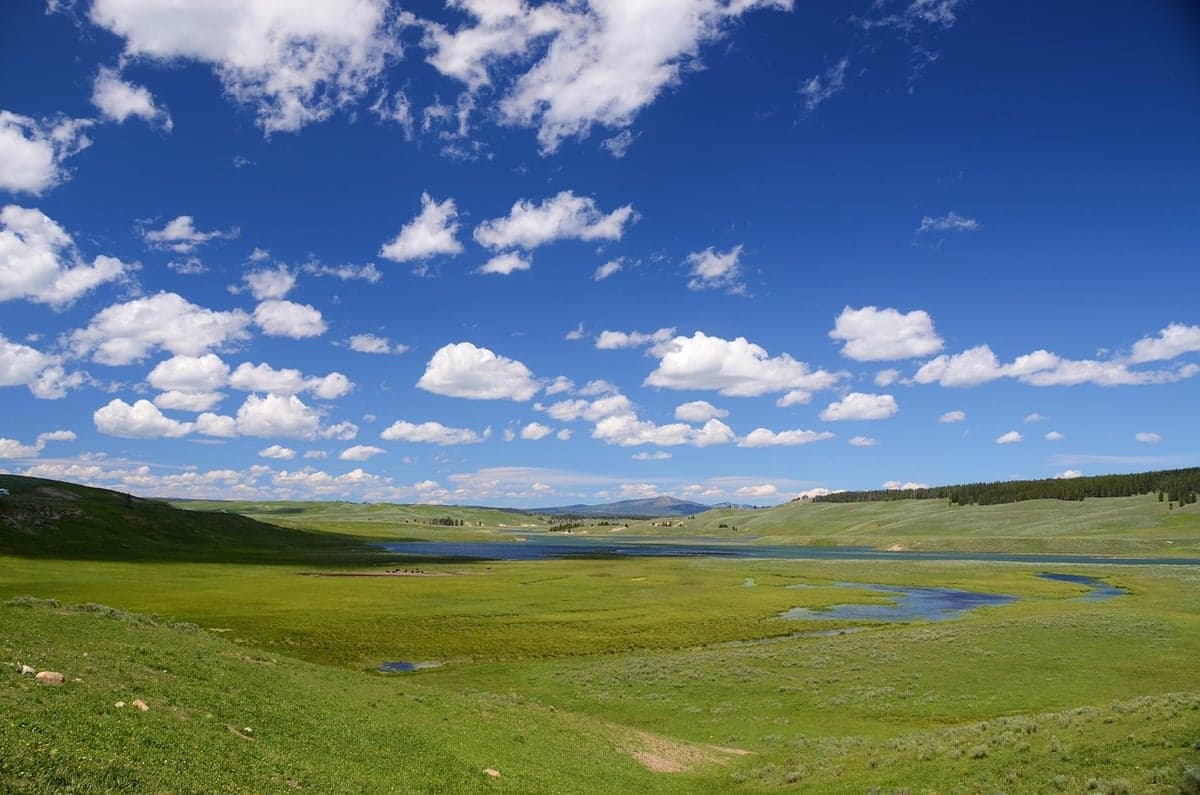
The Dream Stream is about three miles of open meadow water on the South Platte, running from the base of Spinney Mountain Reservoir down into the inlet of Elevenmile Reservoir. Depending on where you start counting and which shop you ask, you will hear anywhere from three to four miles. It sits at roughly 8,700 feet in South Park, in the middle of a treeless basin with 14,000-foot peaks on the horizon and nothing between you and the weather.
Nobody drives to the Dream Stream for the bugs. The hatches are fine. Midges year-round, blue-winged olives in the shoulder seasons, pale morning duns and caddis in summer, Tricos in August. You can find all of that closer to Denver on water that is easier to wade and less exposed. What you cannot find elsewhere is three miles of river sandwiched between two large trout reservoirs, with big fish moving out of one lake or the other twice a year.
That is the whole pitch. Rainbows and cutbows push up out of Elevenmile in late winter and spring. Browns and kokanee drop down out of Spinney and up out of Elevenmile in the fall. There are resident fish the rest of the year, but the reach holds fewer carryover fish than its reputation suggests. Angler's Covey says so directly in their reports. You are fishing a hallway, not a house.
The search data backs up how anglers already think about it. Interest in Dream Stream conditions peaks in October and again in March. It bottoms out in July, which is exactly backwards from almost every other Colorado river. People are not looking up hatch charts. They are asking whether the fish have moved yet.
Colorado Parks and Wildlife rates the reach as Gold Medal water, and it clears that bar by a wide margin. CPW aquatic biologist Tyler Swarr told the Colorado Sun that the Dream Stream carries 4.25 times the Gold Medal standard for biomass and close to five times the standard for quality trout. Those are real numbers from electrofishing surveys, and they explain why the parking lots fill up.
Organize your season around the runs and you will be right most of the time. Organize it around the hatch chart and you will spend a lot of good days on mediocre water.
The spring run is the first big window. Rainbows and cutbows move up out of Elevenmile Reservoir, generally starting somewhere between February and March, with the peak spawning activity in April. Rise Beyond Fly Fishing and other South Park shops have tracked fish pushing in from February onward, and when flows hold or bump slightly, spawners stay in the river into the end of April.
Timing is not fixed. It moves with water temperature, release volume, and reservoir conditions in Elevenmile. Guides who fish it hard are cagey about the exact peak for good reason: publish a date and the gravel gets crowded.
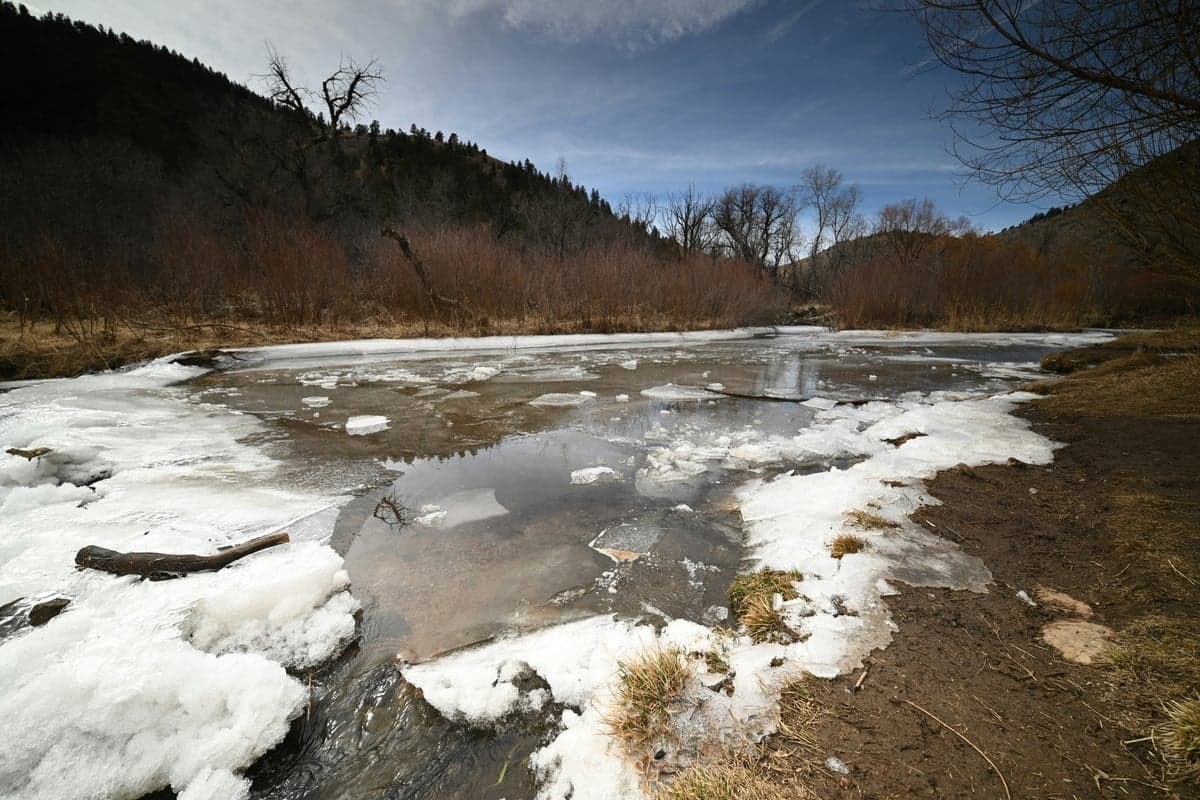
Late winter on an exposed high-country river. Shelf ice on the margins with open water in the middle is normal here through February.
Practically, late February through March gives you fresh fish that have moved but have not settled onto gravel yet. That is the window worth targeting. By mid-April the fish that are still in the river are mostly on redds, and the ethical fishing narrows to staging water. More on that below.
Full ice-over is uncommon on this reach because it is a tailwater with a fairly stable release temperature, but shelf ice along the banks is normal into February and can make the walk-in sketchy.
Be honest with yourself about summer. Once the spring fish drop back into Elevenmile, the reach becomes a technical low-water spring creek with heavy pressure, mediocre density of large fish, and wind that shuts down casting by mid-morning. The resident population is real but it is not what people come for.
Summer also carries thermal risk. This is a shallow, exposed reach with limited depth to buffer heat. Pat Dorsey tells anglers to quit at 67°F, which is a good working number. In hot, low-water years CPW steps in: at the end of July 2026, with the reach running near 94 CFS against a 190 CFS historical average and daily maximums past 73°F, the agency asked anglers to stay off the water from noon to midnight. Those voluntary closures have become a recurring feature of dry summers rather than a one-off.
If you do go in July or August, it is a dawn fishery. Tricos from about 8am to 10am, then terrestrials along the grass, then leave. If you want summer fishing on this river system, the canyon sections hold cooler water and more shade: Cheesman Canyon and Eleven Mile Canyon are both better July calls.
This is the biggest window of the year and the one the search traffic reflects. Large brown trout move up out of Elevenmile Reservoir starting in late September, and unlike the spring rainbows they spread out through the whole reach rather than stacking near the inlet. Fish in the 16 to 22 inch range are the honest expectation. Genuinely large browns show up every year, and shops report fish approaching or exceeding 30 inches, though those are the exception and not the day.
Kokanee are the second act. Landlocked sockeye run out of Elevenmile once lake temperatures drop below about 55°F, turning brilliant red with dark green heads and stacking in deeper runs and gravel pockets. By late October and into November they overlap with the lake-run browns.
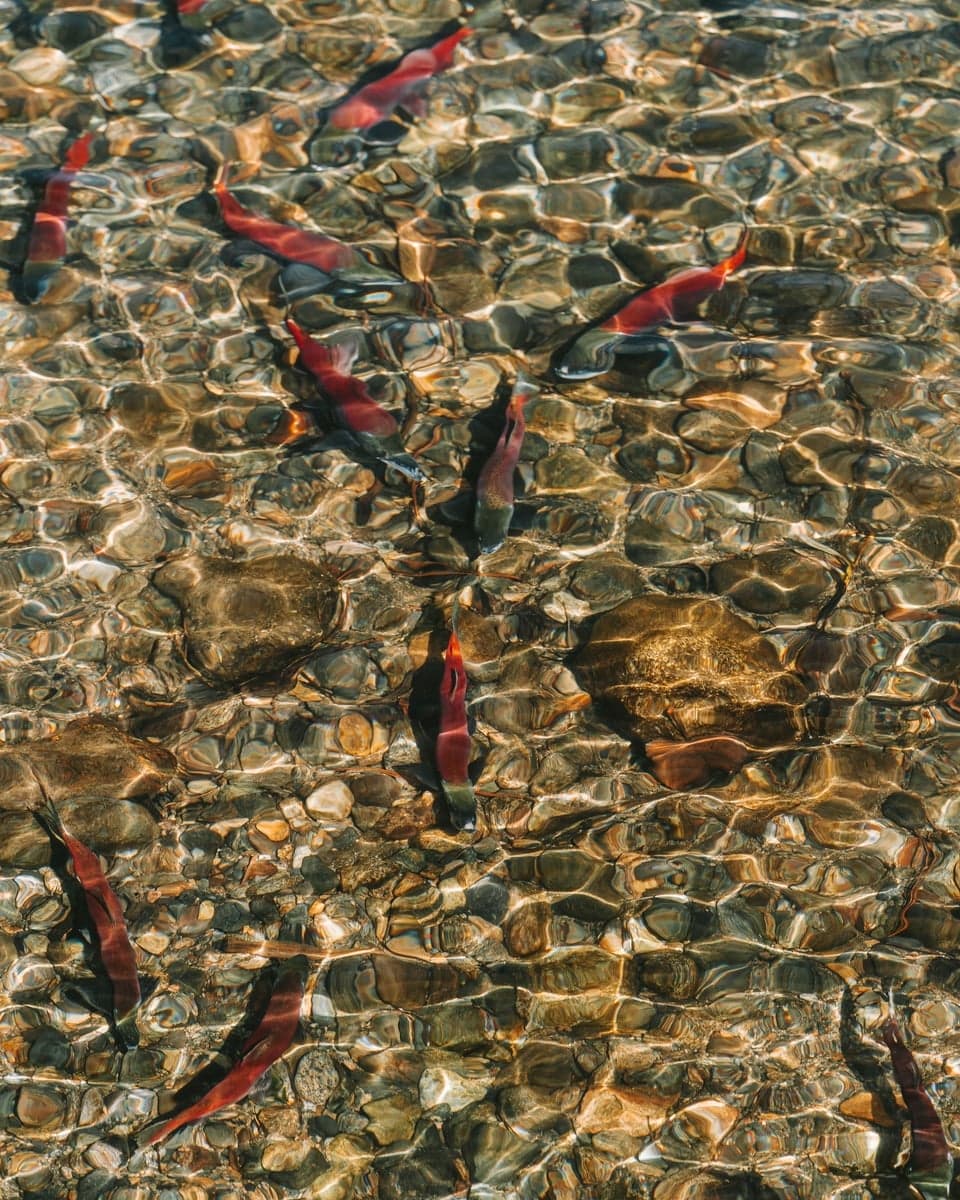
Spawning-colored kokanee stacked over gravel. They show up as water in Elevenmile drops below roughly 55 degrees.
Fall is also when the reach is most crowded and most vulnerable. Portions of the river near the Elevenmile inlet may be posted closed from September 15 through December 31 specifically to protect kokanee spawning, and those postings are enforced. Read the signs at the lot.
Winter is the sleeper. Flows drop, the crowds thin, and the midge fishing can be very good on a calm day. There is usually enough open water to fish through most of the winter, with ice confined to the margins.
The catch is wind. South Park in January produces gusts that make casting a 6X leader a joke, and there is no place to hide from them. Check the forecast twice, and understand that a beautiful blue-sky winter day in Denver often means a 30 mph day in Hartsel. When you do hit a low-wind window, small midges and emergers in the morning and occasional afternoon dry fly activity are the pattern. Other Colorado winter river options are worth having as a backup.
The Dream Stream is entirely a function of what Aurora Water does with Spinney Mountain Reservoir. Spinney is the main storage reservoir for Aurora's Colorado River, Arkansas River, and west Park County water rights, and releases into the South Platte are adjusted daily for fish habitat and water rights accounting. Aurora has generally been cooperative about scheduling releases around spawning periods, but the reservoir exists to store water for a Front Range city, and in a dry year that mission wins.
Most shops point at 100 to 250 CFS as the productive band. Plenty of experienced anglers prefer the lower half of that, roughly 75 to 150 CFS, because the reach wades easily and sight fishing gets realistic. Above 250 CFS the river gets pushy and the sight fishing goes away, but it is still fishable. Below about 80 CFS you are into thin, warm, glassy water where every fish sees you coming and thermal stress becomes the limiting factor.
If you are new to translating a gauge reading into a plan, the CFS primer covers the basics, and the water temperature guide explains why the thermometer matters more than the flow number in August.
There are two gauges worth watching, and they answer different questions.
The gauge above Elevenmile Reservoir sits at the bottom of the Dream Stream and tells you what is actually in the river you are going to fish. That is your primary number. The gauge above Spinney Reservoir measures inflow into Spinney from the Middle Fork drainage, which tells you whether Aurora is filling or drawing down. When inflow is strong, Aurora tends to store and the Dream Stream can stay surprisingly low even in a wet spring. When inflow collapses, releases usually follow it down.
The 2026 season made that relationship obvious. Inflow into Spinney read 3 CFS on July 17, against roughly 260 CFS in a normal year at that date, and the reach spent the summer near 60 to 95 CFS. Both gauges are on RiverReports Colorado.
When Aurora bumps the release, the river turns off for a few hours and then turns back on better. Fish reposition, banks get pushed, and the first day of a significant increase is often slow. Give it a day. A sustained increase in the fall is frequently the trigger that starts browns moving up out of Elevenmile, so a flow bump in late September is good news even if the fishing that afternoon is bad.
The entire reach between the two reservoirs is public. It sits inside Charlie Meyers State Wildlife Area, renamed in 2010 for the longtime Denver Post outdoor columnist. The CPW property page lists it at 1,082 acres with elevations from 8,587 to 9,026 feet.
You need a license or a pass to set foot on it. Since Colorado's 2020 rule change, State Wildlife Areas are no longer open to the general public. CPW's Charlie Meyers SWA page states the requirement plainly: a valid hunting or fishing license or an SWA pass is required for everyone 16 or older. Youth under 16 are exempt. Getting caught without one runs $100 plus $39.50 in surcharges and five license suspension points. If you are fishing, your license covers you. If a non-fishing friend comes along to walk the dog, they need a pass.
Access is off Park County Road 59, also signed as Thirtynine Mile Road, which runs between the two reservoirs.
The standard local move is to drive past the first full lot, park at the emptiest one, and walk. Open meadow means you can see where people are before you commit.
There is no bad terrain here. Flat grass, no bushwhacking, no scrambling. What there is instead is total exposure. Fish in this reach see you coming from a long way off, because there is nothing between you and them: no trees, no boulders, no broken water. Stay low, approach from downstream, and stop short of where you think you need to be. Wading straight up the middle of a run because the walking is easy is the most common way people blow a good pool here.
There is also no shade, no shelter, no water, and no bathroom. The nearest store is several miles away in Hartsel or Lake George.
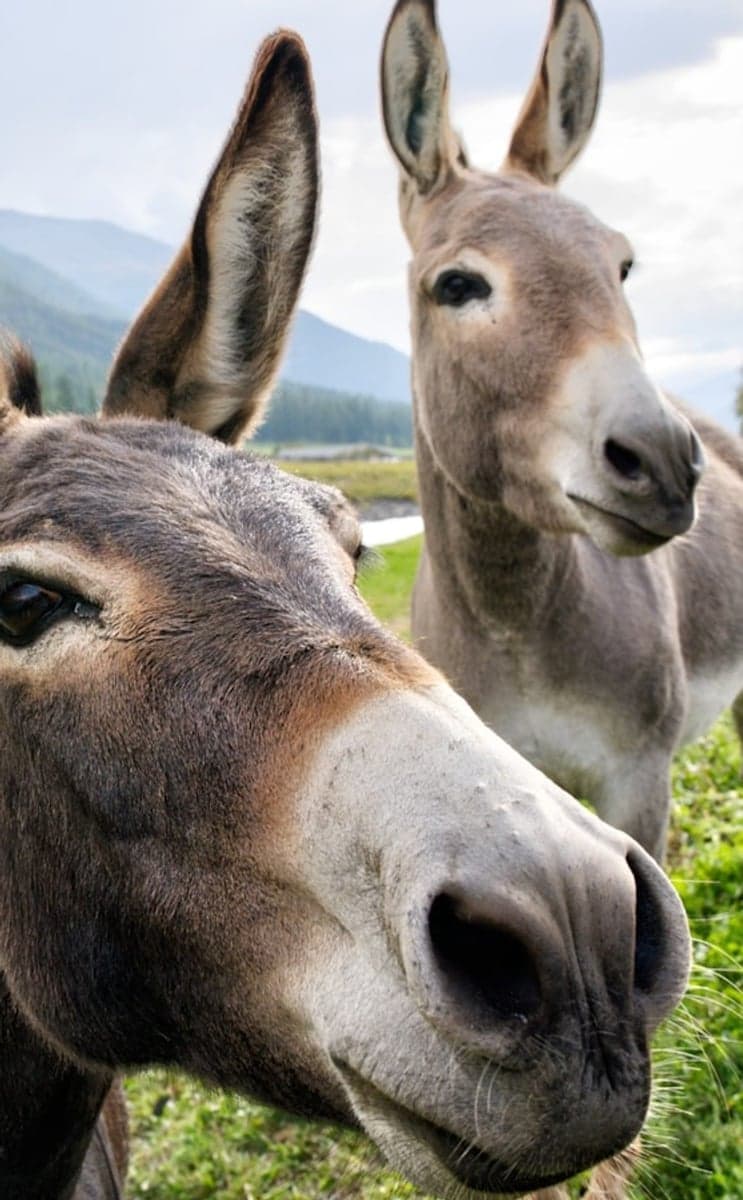
Two donkeys, up close and entirely unbothered. There are donkeys out here, and if you fish the reach often enough you will meet them. South Park has been burro country since the Fairplay mines ran on them, and Fairplay still races them every July. This is working ranch country and open range too, so watch for cattle on CR 59.
Tomahawk State Wildlife Area comes up in a lot of Dream Stream searches, and it is worth being clear that it is a different piece of water. Tomahawk is 1,655 acres on the Middle Fork of the South Platte, five miles north of Hartsel on Highway 9, upstream of Spinney entirely. It is a smaller, more intimate stream with its own character and the same SWA license requirement. Worth a visit, but it is not the Dream Stream and it does not get the migratory runs.
This is the part of Dream Stream etiquette that gets the most argument and the least practice. Spawning fish here are large, visible, and sitting in shin-deep water in an open meadow. That combination makes this one of the most notorious places in Colorado for anglers fishing to fish on gravel.
The core distinction is simple. Fishing during a run is fine. Fishing on the gravel is not.
A redd reads as a bright, scrubbed oval of clean gravel against a darker, siltier bed, with a scooped pit at the upstream end and a raised mound of loose gravel below it. It shows up in pool tailouts and at the heads of riffles, which are exactly the spots you would otherwise walk through on the way to somewhere better. Once you have seen a few you cannot unsee them, and they stay visible for weeks after the fish that built them have moved on. The full guide to spotting redds and fishing the fall spawn covers the biology, the incubation timeline, and the research on what a single wading pass actually costs.
Fish below the redds. Large lake-run fish stack in the deeper water downstream of spawning gravel, feeding on drifting eggs, and those are legitimate targets. Colorado Trout Hunters, who guide this water, put it bluntly: target fish before they start spawning and in the deep water below the redds, and once they begin spawning, leave them alone.
Target staging fish. Early in a run, before fish settle onto gravel, they hold in normal trout water and eat normally. That is the best fishing of the run anyway, and it carries no ethical cost.
Watch your feet more than your fly. The damage is mostly done by boots, not hooks. Wear polarized glasses, look at the bottom before every step, and walk the bank around any bright gravel patch. This applies well past the spawn itself, because eggs sit in the gravel through winter.
Skip a fish rather than argue about it. A hen sitting on a nest with a male behind her is not a difficult call.
Egg patterns are legal here and they work on fish feeding below redds. That is a different thing from dropping an egg into a nest, and most people know the difference even when they pretend not to.
Wind is the defining condition here and it deserves the same attention you give the flow number.
There is no shelter at 8,700 feet in a treeless basin. Wind that would be a nuisance on a canyon river ends the day here. Local reports describe South Park gusts as the primary reason a Dream Stream trip fails, and calm sunny days as the ones that fish best. That is unusual advice for a technical tailwater, where overcast normally helps, but the wind penalty outweighs the light advantage.
Rod choice. A 9-foot 5-weight is the honest all-around answer, even though the fish and the fly sizes argue for a 4-weight. The extra backbone buys you casts in 15 mph wind that a lighter rod will not make. Some regulars go to a 6-weight in fall for streamers and wind together.
Leader. Long, fine leaders are what this water demands and what the wind punishes. Carry both: a 12 to 14 foot 6X or 7X setup for calm mornings, and something shorter and stiffer, around 9 feet to 5X, for when it kicks up. Fluorocarbon turns over better in wind than nylon at the same diameter.
Timing the day. Wind typically builds through late morning and peaks in the afternoon. That points at the same schedule the thermal concerns point at: be on the water at first light, fish hard through mid-morning, and treat the afternoon as a bonus.
Thunderstorms. From roughly July through early September, afternoon convection over South Park is routine, and you are the tallest thing in a wet meadow holding a graphite rod. There is nowhere to shelter. Watch the western horizon, leave early, and do not talk yourself into one more run. Getting back to the car from the far end of a walk-in takes 20 to 30 minutes.
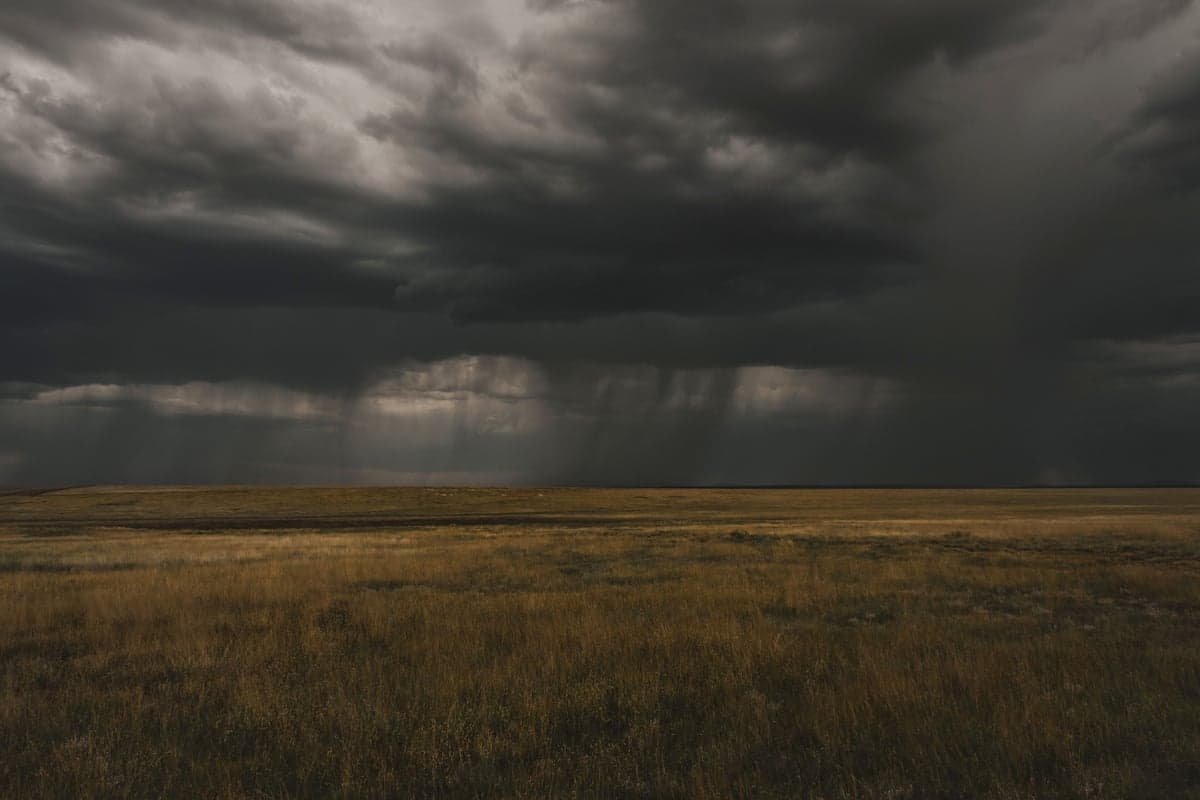
Afternoon storms build fast over open high country with zero cover on the water. Leaving early is the plan, not the fallback.
Layers and eye protection. Weather here swings hard. Regulars carry a wind shell year-round. Polarized glasses are not optional: you need them to spot fish, to spot redds, and to keep a wind-blown size 22 out of your eye.
The reach between Spinney Mountain and Elevenmile reservoirs runs under Colorado's special regulations, and they are simple and strictly enforced.
Confirm current rules with Colorado Parks and Wildlife before you go, because posted closures can shift year to year and CPW adds voluntary thermal closures on short notice during dry summers. Colorado's public and private water access rules are worth understanding generally if you plan to fish more of South Park, where public and private water alternate in ways that are not obvious from the road.
The Dream Stream is not a secret and has not been one for decades. On a good October Saturday there are a lot of people, and the pressure concentrates near kokanee staging areas and the most accessible lots. Local reports are candid about it: this is one of the most pressured fisheries in Colorado, and solitude is not on the menu.
The mitigation is straightforward and works. Fish weekdays. Park at the far lot. Walk further than the person ahead of you. Three miles of open meadow is enough to spread out if people are willing to move, and most are not.
The other honest caveat is about the fish themselves. These are large fish and hard fish, and the two go together. They live in clear, slow, shallow water and they get shown flies constantly. Landon Mayer, who has guided this water for years, described them to the Colorado Sun in the plainest possible terms: they are not easy, and there are giants living in the river. Both halves of that are true. A good day here might be two or three fish. A bad day is zero, and zero days are common enough that you should plan for one.
Fish sizes in the 16 to 22 inch range are the realistic target during a run, with typical resident fish in the 10 to 18 inch class. Spawning-run fish approaching 10 pounds turn up during the three to four week peak windows.
Worth knowing for context: the reach you fish today is partly engineered. CPW completed a habitat restoration in 2013, a major flood in 2015 undid much of it, and another storm caused flash flooding in 2017. In 2021 crews rebuilt the damaged sections again, weaving nearly 60 root-wad trees, 102 logs, and over 200 cubic yards of slash into eroded banks and placing 15 tons of rock to firm up riffles and narrow the channel. The work cost roughly $100,000 in insurance money and CPW capital construction funds against a private contractor estimate of $1.2 million.
The channel widening those floods caused was the real problem: shallower water, less cover, and fine sediment settling into spawning gravel. Structure you find along the banks may well be somebody's rootwad from a decade ago.
The South Platte offers several distinct fisheries and they are not interchangeable.
Cheesman Canyon and Deckers sit far downstream, below Cheesman Reservoir, and fish like a technical granite-canyon tailwater with real hatches and resident fish. If you want a hatch-driven day with cover and shade, that is where to go. Start with the Cheesman Canyon guide or the more forgiving water at Deckers.
Eleven Mile Canyon, immediately below Elevenmile Reservoir, is the closest alternative geographically and the most useful backup plan when the Dream Stream is blown out by wind or closed to afternoon fishing. It has road access, shade, and cooler water. See the Eleven Mile Canyon guide. That canyon is also serious whitewater below the dam: American Whitewater rates the eight-mile run from Eleven Mile Reservoir to Lake George as Class III-V(V+), with a Class V rapid called Big Bang near the top and Supernova at the bottom. That is a run for experienced boaters only, and it has no bearing on the Dream Stream itself, which is far too small and too shallow to float.
The Dream Stream is the migratory piece. It does something none of the other sections do, twice a year, and it is worse than all of them in July.
Getting there. From Colorado Springs, US-24 west about 55 miles over Wilkerson Pass, then south on CR 23 and CR 59 past Spinney Reservoir. From Denver, US-285 south through Fairplay, then Highway 9 south to Hartsel and CR 59. Roughly two hours from Denver, an hour from Colorado Springs. Winter driving over Wilkerson Pass or through South Park can be genuinely bad, and the basin holds cold air.
Shops and guides. Tumbling Trout in Lake George is the closest shop to the water at 38283 Hwy 24, (720) 363-2092, and runs full-day walk-and-wade trips on the Dream Stream. South Platte Fly Shop in Woodland Park, (719) 686-8990, posts a dedicated Dream Stream and Spinney report that is one of the more reliable public sources for current flows and closures. Angler's Covey in Colorado Springs, (719) 471-2984, is open 6am to 6pm daily, which matters when you want to be at the water at first light. Blue Quill Angler in Evergreen, (303) 674-4700, covers the reach for Denver-side anglers.
Guided rates. Colorado Trout Hunters runs $550 for one angler and $650 for two on a full day, $400 and $500 for a half day, with a 50% non-refundable deposit. Book the spring run by January and the fall run by August. Guides who target migratory fish here are worth the money precisely because they know when the fish moved, which is the one piece of information you cannot get from a gauge.
Camping. There is no camping along the river itself. Eleven Mile State Park, just downstream, has developed campgrounds and is the practical base for an early start.
The Dream Stream page shows the one number that decides your trip: what Aurora is releasing. Three readings matter.
It is all on the Colorado flow page. When South Park is unfishable, the month-by-month Colorado guide is the faster route to a backup.
Weekly flow updates and fishing intel.
© 2026 RiverReports, Inc.